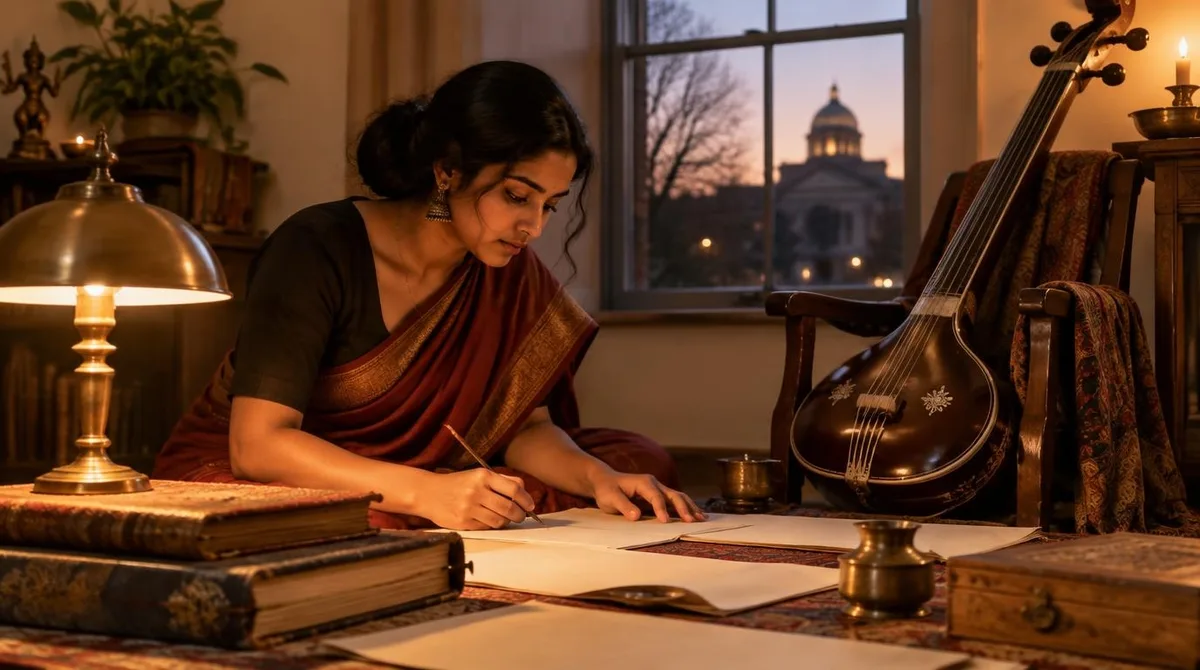
On Nov. 15 at 6:30 p.m., the Penn State student chapter of the Society for Indian Music and Arts will present an evening of Prabaṅdha Gāna in the Flex Theatre of the HUB-Robeson Center at University Park. Prabaṅdha Gāna is a genre of Indian classical music that was prevalent in medieval India, according to Penn State. The recital, composed by Pt Arijit Mahalanabis, will present a Prabaṅdha Gāna in its entirety, reconstructed using literary evidence.
The announcement is short, and most coverage will treat it as a calendar item. It is worth a slower read. A student choir — largely Penn State students, with help from the broader SIMA community — will perform a piece nobody alive has heard as it originally sounded. That is either a revival or a well-informed invention, depending on how much weight you think "reconstructed using literary evidence" can carry. The honest answer sits between the two, and the trade-offs are worth naming before the lights go down.
What exactly is being revived?
Here is what the record supports. The genre existed and was prevalent in medieval India. The specific work on the program was reconstructed by the composer from literary evidence — written texts, not surviving performance practice. The performers are mostly undergraduates. That is the whole evidentiary base, and it is thin in a specific way: literary evidence can establish that a form existed, what it was called, and something about its structure. It cannot establish how it sounded in a medieval hall.
A skeptic will say that makes the evening speculative. A defender will say every performance of historical music involves choices, and a documented reconstruction is more honest than an unmarked modernization. Both readings are fair. The second one has the better of it, for one reason: the program states its method up front. An audience told the piece was rebuilt from literary evidence is being asked to hear a scholarly argument, not a time machine.
Why students, and why here?
The choice to build the performance around the Penn State student body is the most consequential decision in the announcement, and it cuts both ways. Students get to carry the work, which is how a form becomes part of someone's musical life rather than a museum label. The instrumental and choral sections "largely comprise the Penn State student body with assistance from the broader SIMA community," per the university's notice — so the expertise is distributed, not concentrated in a visiting ensemble.
The trade-off is precision. A reconstruction argued from texts demands performers who can execute a composer's interpretive decisions exactly. Students learning a unfamiliar genre in a single production cycle will make the piece theirs, with all the approximation that implies. Whether that approximation is a flaw or the point depends on what you think the evening is for. If it is a scholarly demonstration, precision matters most. If it is a community event — a campus organization putting on a show in the student union, tickets on sale, questions routed to a student email address — then participation is the product, and the reconstruction is the occasion for it.
There is also a quieter observation about place. A medieval Indian genre staged in the Flex Theatre of a Pennsylvania student center is a reminder that cultural transmission runs through unglamorous rooms. The student center performance has more in common with other campus and community stages than either has with a concert hall, and the survival of unfamiliar forms has often depended on exactly this kind of modest venue — the same pattern behind why community theaters keep closing and what gets lost when they do.
The second opinion: hold the revival framing loosely
The temptation with an event like this is to write "a lost art form comes back to life." Resist it. What is actually happening on Nov. 15 is a contemporary composer's reading of medieval textual evidence, performed by students, at a university, under the banner of a student chapter of the Society for Indian Music and Arts. Every clause of that sentence is verifiable from the announcement. "Comes back to life" is not, because nobody involved claims the reconstruction matches the medieval original — the method, literary evidence, tells you it cannot.
The fairer frame is that reconstruction is a living practice, not a resurrection. The strongest version of the skeptical view: audiences may leave believing they heard medieval India, and that belief would be wrong. The strongest version of the charitable view: the program's own language prevents that mistake, and a documented reconstruction invites exactly the productive argument this article is having. On the evidence available, the charitable view wins — but only because the announcement is candid about its method. That candor is doing real work, and it deserves more credit than it usually gets.
What to watch when the evening is over
Two things will tell you what this event really was. First, whether the reconstruction travels: a work staged once by a student chapter can end there, or it can enter the broader SIMA community's repertoire, which the announcement hints at by naming that community as a support for the student performers. Second, whether the method stays visible. If future presentations keep saying "reconstructed using literary evidence," the practice is being honest with its audiences. If the qualifier quietly drops away and the piece becomes simply "Prabaṅdha Gāna," then the revival framing will have won by attrition — and the line between a scholarly argument and a settled canon will have blurred without anyone deciding it should.
Tickets are available through the organization, and questions can be directed to [email protected] or the SIMA website, according to the university's notice. For readers tracking how Americans actually encounter unfamiliar cultural forms — through campuses, community halls and student labor rather than marquee institutions — this is a small event worth putting on the calendar, and worth attending with the right expectations. It belongs to a wider pattern we have followed elsewhere, from what third places are and why they vanished to who owns a song from the American Songbook: the question of who gets to carry a tradition, and how much of it they actually hold. We covered a connected angle in Who Owns a Song From the American Songbook?.