America's regional and community theaters numbered in the thousands by the 1980s, and the American Theatre Association's successors have watched a steady trickle of them go dark ever since. Theaters close not because audiences vanish overnight but because the model — volunteer labor, subscriber donations, and a building that always needs a roof — has almost no margin for error. The closures that make local headlines are usually a decade in the making.
What kind of theater are we actually talking about?
Not Broadway, and mostly not the big regional nonprofits either. Community theater means the volunteer and semi-professional stages — an estimated several thousand nationwide — that put on four or five shows a year in converted churches, Elks lodges, and 1970s purpose-built black boxes. Above them sit roughly 70 member theaters of the League of Resident Theatres, the professional nonprofit tier, and above that Broadway and tours. The closure problem concentrates in the bottom tier and increasingly nibbles at the middle.
The distinction matters because the finances differ. Professional regional theaters pay union scale and live on a mix of ticket sales, donations, and endowment income; the classic rule of thumb, taught in arts administration programs since the 1980s, is that tickets cover about half the cost of the art and donors cover the rest. Community theaters run on cheaper labor — yours, donated — but have no development staff, no endowment, and often no reserve fund at all. One failed musical can end a fifty-year institution.
Is attendance really the problem?
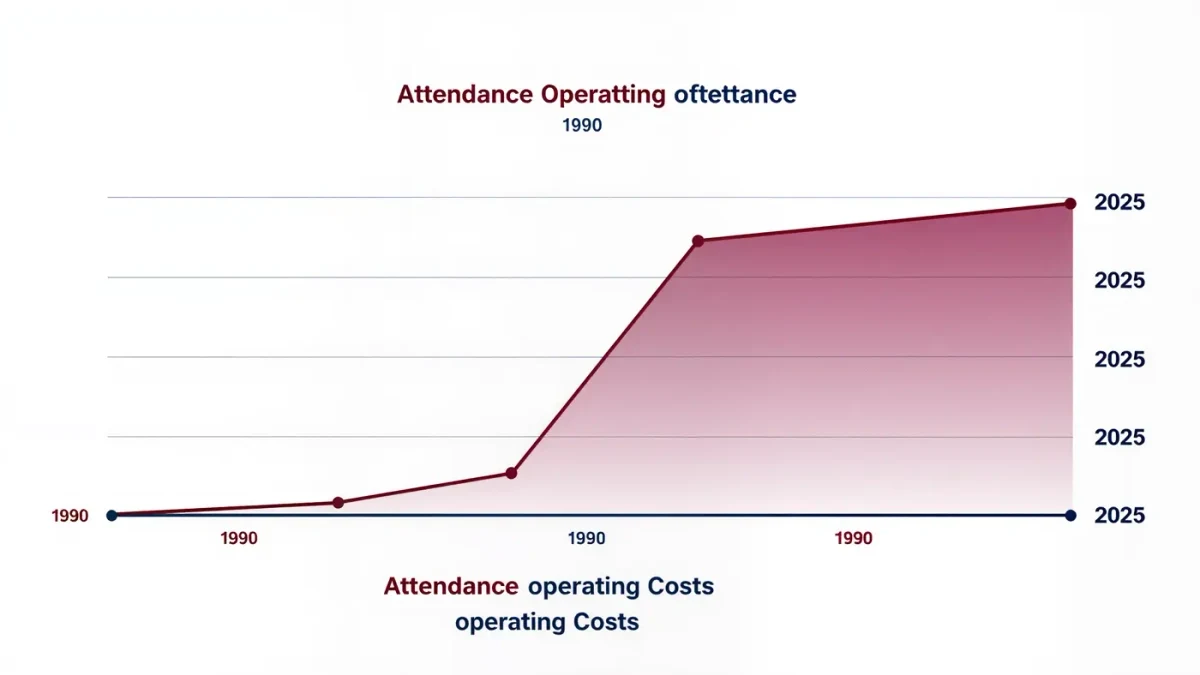
It is a problem, but a slow-moving one. The NEA's Survey of Public Participation in the Arts recorded attendance at nonprofit theater — musicals and plays combined — declining fairly steadily from the early 1990s through 2022, with the drop for non-musical plays especially steep, falling from double digits to single digits as a share of adults. Musicals held their audience; straight plays aged theirs.
The age curve is the part that keeps artistic directors up at night. The reliable play subscriber of 2025 is the same person who subscribed in 1995, thirty years older. Surveys by the Theatre Communications Group, the field's membership organization, have shown for years that the average nonprofit theater audience skews well over fifty, while marketing budgets built on season brochures and direct mail reach exactly that audience and no one else. Younger audiences do come — for the right show, on the right night, often bought the same week — but they behave like restaurant customers, not subscribers, and a theater built on subscription math cannot pay its mortgage on walk-ins.
What happened to the money?
Three things, in order. First, the 2008 recession taught donors and foundations that 'temporary' cuts last a long time; many mid-sized theaters never rebuilt their giving base. Second, production costs — rights, materials, insurance, and above all housing for artists in the cities where theater people want to live — rose faster than ticket prices could honestly follow. Third, the pandemic shut every stage in the country in March 2020, and while federal relief funds like the Shuttered Venue Operators Grants kept many theaters technically alive, the post-2021 recovery favored institutions with brand names and tourism traffic.
Relief money disguised the structural problem, which returned with company size attached. In 2023 and 2024 several prominent nonprofit theaters announced they would drop Actors' Equity contracts and return to non-union production — the Pasadena Playhouse and a wave of smaller companies made versions of this move — because the arithmetic of union contracts, rising minimum salaries, and stagnant attendance no longer closed. Equity calls it a crisis for the profession; the theaters call it survival. Both are describing the same spreadsheet.
Why do small-town stages close even when seats are full?
Because full seats were never the business model. A 150-seat house selling out five weekends grosses, generously, a few tens of thousands of dollars, against rights fees, sets, costumes, insurance, utilities, and rent. Volunteer theater works only when the volunteers' time is genuinely free, and the volunteer pool has thinned. The civic clubs that once supplied boards and box-office staff — the Elks, the Rotary, the church guilds — have lost members across American life since the 1990s, a decline measured and mourned by Robert Putnam in Bowling Alone back in 2000. Community theater is downstream of civic participation, and the stream is lower.
The building is the other killer. Many community theaters own aging structures donated in more confident decades, and deferred maintenance compounds quietly until a furnace fails in January or a boiler inspection closes the building outright. Capital campaigns for a volunteer organization with two hundred donors are hard; for a town where the largest employer has changed hands twice, they are close to impossible. When a sixty-year-old theater closes, the proximate cause is usually a roof, but the underlying cause is that nobody in 1975 budgeted for 2025.
What does a closing season actually look like?
The pattern is recognizable to anyone who has served on a small board. A theater announces a 'hiatus' for the coming season, framed as a chance to regroup. The artistic director, usually the only full-time employee, departs 'to pursue other opportunities.' The building stays technically open for rentals — dance recitals, comedy nights, wedding receptions — while the subscription machinery quietly rusts. Two years later the property is sold, and the closing press release cites the pandemic, or the economy, or the death of a beloved founder, all of which are true and none of which is the whole story.
The whole story is that live theater is a manufacturing business with craft economics and no scale. Every production is a new prototype built by hand, opened on a deadline, and sold for a fixed price regardless of cost. Broadway absorbs this through premium pricing and tourism; the regional tier absorbs it through donations and endowments; the community tier absorbs it through volunteers, and there is no tier below to absorb it further. When a stage with zero slack hits two bad years in a row, closure is not a failure of passion. It is arithmetic completing itself.
What would have to change for the closures to stop?
Honestly, the expectations. The theaters doing well in the 2020s tend to share traits: they program for their actual town rather than a hypothetical New York audience, they keep seasons small and casts lean, they treat bars and rentals as serious revenue, and they have found at least one institutional partner — a school district, a municipality, a library system — that treats them as infrastructure rather than entertainment. Some of the most durable stages in the country are, in effect, civic buildings that occasionally do theater.
The alternative view deserves respect: some closing is natural. Art forms decentralize, and the energy that built 3,000 volunteer stages between 1930 and 1980 may simply live elsewhere now — in black-box comedy, in school programs, in the immersive and site-specific work cities have grown fond of. The theater has survived the death of the repertory system, the censorship fights, television, and several financial reckonings. It will survive this one. Whether the specific institution with the marquee on Main Street survives is a much narrower bet, and lately the house is betting against.