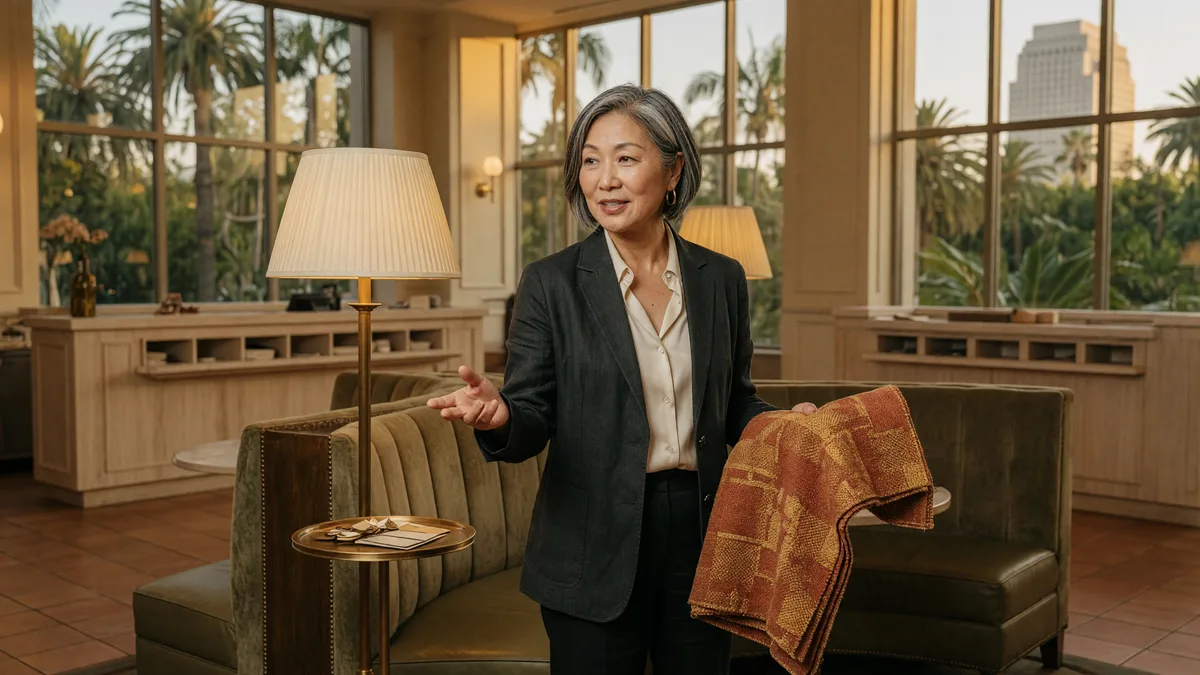
The Society has named Sandy Lu as its Design Director for Hotel Designs, and the announcement is worth more than a passing glance. According to Hotel Designs, Lu will shape the studio's creative direction across boutique and lifestyle hotels, mentor the design team, and push the studio into higher-tier lifestyle projects, food and beverage work, and branded residences.
The timing matters. Alissa Brandt, the studio's Vice President of Interior Design, framed the hire around an anniversary: The Society is celebrating 10 years and, in her words, looking ahead to "the next chapter." Lu arrives with more than 20 years in hospitality design, including a decade as Hospitality Design Director at CHIL Interior Design, earlier work at Wimberly Interiors in Los Angeles, and a career that began in Vancouver, B.C.
What makes this a story about how American design culture works — not just a personnel note — is the method Lu describes. "Great hospitality design is about listening first," she told Hotel Designs. "To the location, the operator, the guest. The result should feel like it belongs exactly where it is, and nowhere else." That is a claim about place, and it sits inside a long American argument about what hotels, and the public rooms inside them, are for.
Why does a design director hire matter to anyone outside the industry?
Because the interiors a studio like The Society produces become the settings where a lot of American social life happens. Lobbies, restaurants, and lounges in boutique and lifestyle hotels are places where travelers, locals, and workers share space. When a design leader says the goal is for a room to "belong exactly where it is," she is taking a position against the interchangeable look that travelers complain about and that the industry keeps producing anyway. Whether she can deliver on that across a growing portfolio is the open question.
It is also a story about how studios grow. Lu's stated priorities include deepening relationships with operators, ownership groups, and hotel brands. In plain terms: the person who decides what rooms look like will spend much of her time managing the people who pay for them. Brandt's praise of Lu centered on exactly that balance — "deep hospitality experience, a design instinct that fits everything The Society stands for, and a real commitment to the people she works with." We covered a connected angle in The 1963 Grocery Budget That Still Decides Who Counts As Poor.
What does her career path tell us about the studio's ambitions?
The résumé reads like a map of the North American hospitality design world. Lu began in Vancouver, moved to Wimberly Interiors in Los Angeles, and spent 10 years at CHIL Interior Design overseeing design strategy and project leadership. Her work has included projects with brands such as Autograph and Le Méridien. A studio marking its first decade does not usually hire a 20-year veteran to stand still. The expansion targets Hotel Designs lists — higher-tier lifestyle projects, food and beverage, branded residences — are the segments where design decisions carry the most money and the most identity.
Lu herself described the approach she will carry over: establish a story at the outset of each project and carry it through every decision to the finished work. That narrative method is common in boutique design talk, but it is also practical. A property with a coherent story is easier to sell to an ownership group, easier to brief an operator on, and easier for a guest to remember.
What should we watch as the next decade starts?
Two things. First, mentorship. Both the studio's announcement and Lu's own comments put studio culture — collaboration, mentorship, connection — at the center of the role, alongside client work. Studios that expand quickly often strain their junior staff first; a design director who says people are the point will be judged on whether that holds. Second, the expansion itself. Branded residences and food and beverage are different disciplines from hotel guest rooms, and the "listening first" philosophy will be tested most where the context is newest.
There is a broader cultural thread here too. Americans keep renegotiating what shared spaces look like and who they are for — a question that runs from public parks to hotel lobbies. The way a studio like The Society answers it, one property at a time, is one of the quieter ways design shapes daily life. Lu's appointment is a small, well-documented data point in that larger story: a 10-year-old studio, a 20-year career, and a stated bet that the next decade belongs to rooms that sound like where they stand. For related coverage, see Why Americans Keep Rediscovering Their Public Parks.
What the evidence does not yet show is results. The announcement describes intentions, not completed projects, and no timeline for the new sectors was given. The fair reading is that The Society has made a deliberate, experienced hire at a deliberate moment — and that the interesting part starts now.