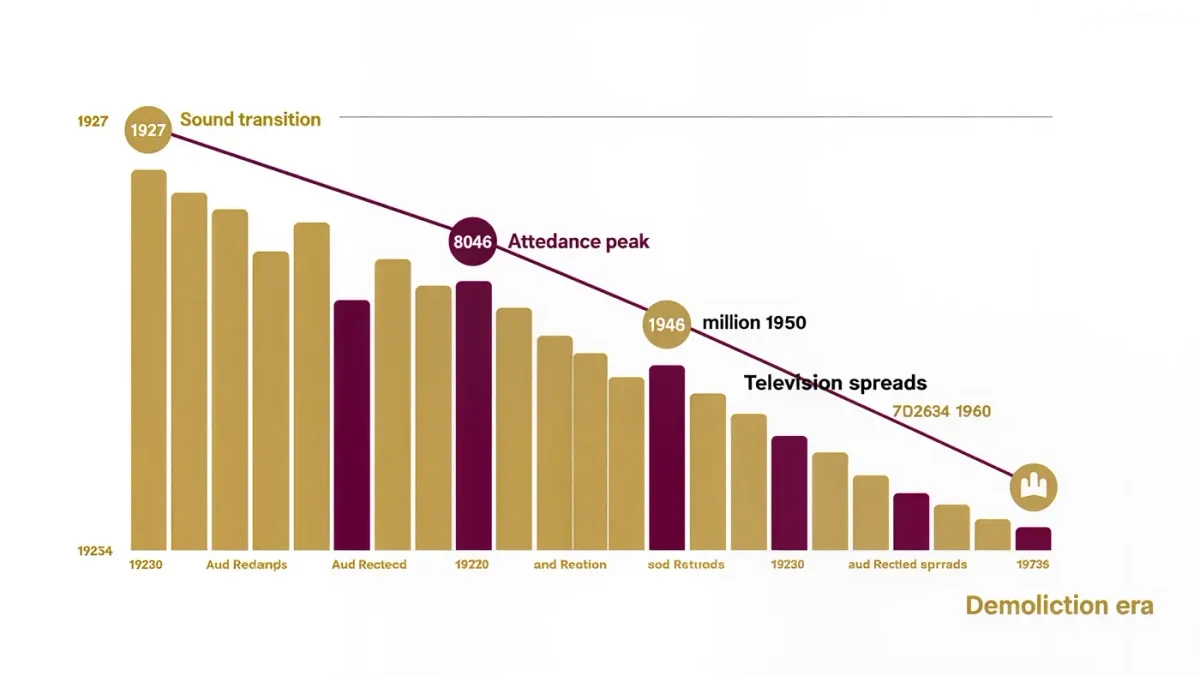
At the boom's height, the United States had tens of thousands of movie theaters and weekly attendance that ran to as much as 80 million in the late 1920s, in a country of 120 million people. The grandest of the venues were palaces in the literal vocabulary of the business: New York's 5,920-seat Roxy opened in 1927 with its own hospital and a pipe organ requiring an operator's license, and Radio City Music Hall followed in 1932 with about 6,000 seats. Most of these buildings are gone, and the survivors are among the most intensively loved structures in American cities.
What was a movie palace, exactly?
A purpose-built film theater designed to feel like a European fantasy, at a scale no opera house had attempted. The type emerged in the 1910s, matured with the 1920s boom, and was defined by a small group of specialist architects: Thomas W. Lamb, the Rapp brothers of Chicago, and John Eberson, inventor of the atmospheric style, whose ceilings featured projected stars drifting across painted night skies. The interiors borrowed eclectically from Versailles, Moorish Spain, Byzantium, and ancient Egypt, sometimes within a single building, on the theory that a plumber's Saturday night should be spent inside architecture otherwise reserved for royalty.
The service matched the setting. Palaces employed uniformed ushers, some trained in military-style drills at chains like the Roxy organization, full orchestras, soloists on the mighty Wurlitzer during intermissions, lounge attendants, nurseries, and in the flagship houses, hotels' worth of back-of-house staff. The program was a continuum, newsreel, cartoon, stage revue, feature film, and the building taught audiences that moviegoing was an event measured in hours. Admissions in the big houses ran from roughly 25 cents to a dollar in the 1920s, serious money that bought, deliberately, more evening than a theater or concert hall could plausibly offer.
Who built them, and why so many?
Studios and chains, for competitive reasons that seem obvious only in retrospect. The 1920s vertically integrated film industry, in which Paramount, Fox, Loews, and Warner Bros. owned production, distribution, and exhibition, discovered that a spectacular house locked in a city's first-run audience, and the palaces became the exhibition arms' flagships. Approximately 20,000 movie theaters operated in the United States by the decade's end, of which the palaces proper were a few hundred, the rest being neighborhood and small-town houses that copied the styling at lower wattage.
The economics ran on the boom and broke on schedule. Construction and payroll were enormous fixed costs, and when sound arrived in 1927-1929, every theater wired for talking pictures, another capital outlay; the stock crash of 1929 and the Depression emptied the palaces on which the debts sat. Thousands of movie theaters closed between 1930 and the mid-1930s, and the exhibition business consolidated, limping back to prosperity by the war years. The palace era's grand gestures were largely over by 1932, Radio City's opening serving as both climax and epitaph, since the Depression had already made the type unfinanceable. In 1948, the Paramount Decisions forced the studios to divest their theater chains, breaking the vertical integration that had built the buildings in the first place.
What did an evening at a palace actually involve?
Protocol, from curb to curtain. Programs were printed, and ushers with flashlights walked patrons to seats even in half-empty rows, since the houses ran reserved-seat policies at many performances. The organist played the crowd in; the orchestra played the picture out; the stage revue, at the largest houses, featured everything from opera singers to precision dance lines, and the intermission was long enough for a full lounge service. Patrons dressed for it, a convention that outlived the buildings by decades in memory, and the whole choreography communicated one message: that the customer, whatever the week had been like, was for these hours a person of consequence.
The scale of employment was civic in itself. A flagship palace could carry several hundred staff, from projectionists, members of a strong union whose contracts shaped exhibition economics for decades, to restroom attendants, and the payroll rippled through downtown suppliers, launderers, and musicians. When the houses emptied in the 1950s and 1960s, the job losses and the building closures hit city centers together, which is part of why the palaces' fates became entangled with the whole story of downtown decline, and why their restorations, when they came, were staged as acts of economic as much as architectural recovery.
Why were so many demolished?
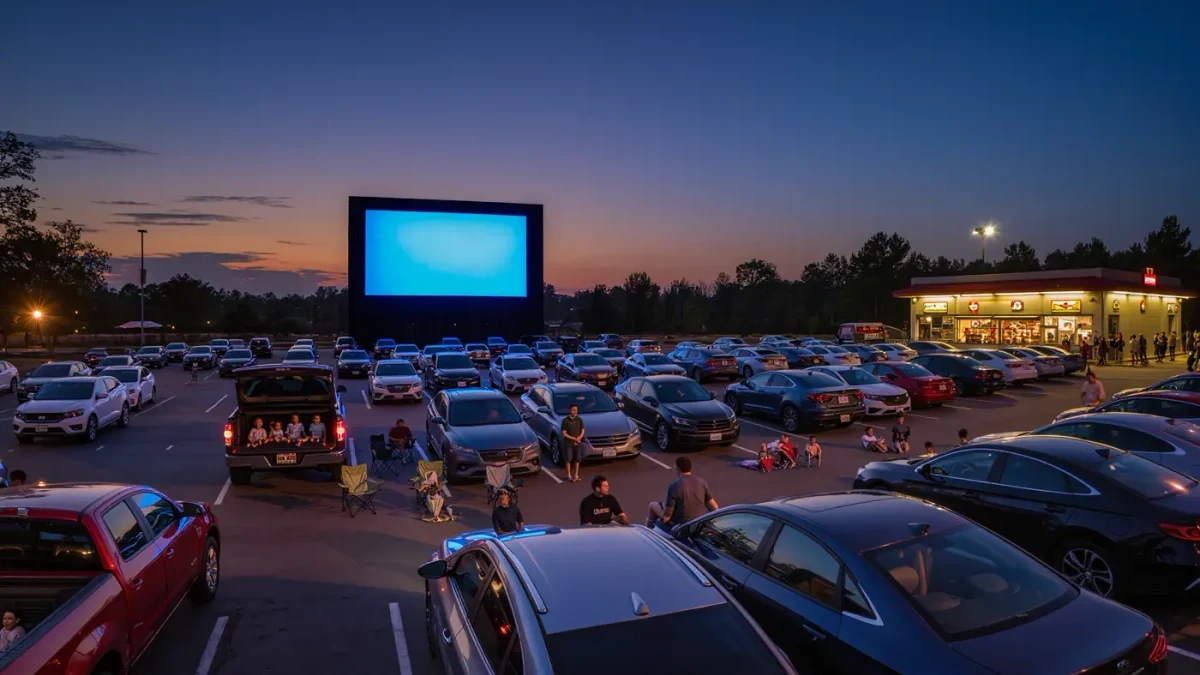
Because their value was in the land and their costs were in the ceiling. Television in the 1950s cut weekly movie attendance from its 1946 peak of over 80 million to a fraction of that within fifteen years, and a 5,000-seat house operating at a fifth of capacity could not pay its ushers. Suburbanization moved audiences to drive-ins and shopping-center cinemas that cost a tenth as much to run; downtown palace sites, in the era of urban renewal, were worth more as parking lots and office towers than as ornate liabilities. The Roxy, the type's most famous example, was demolished in 1960 despite protests, a demolition that itself became a landmark in the growth of architectural preservation consciousness.
The destruction ran hot through the 1960s and 1970s, and estimates of palace losses run to the large majority of the major houses: the pages of theater historical societies read as casualty lists, with destruction dates where reopening dates should be. What slowed it was a convergence of preservation law, tax credits for historic rehabilitation, and the discovery that a restored palace, run as a performing arts center or concert venue, could anchor a downtown revival. The buildings that survived to roughly 1980 mostly survive still, frequently with their organs rebuilt by volunteer societies and their chandeliers rewired at heroic expense.
Which ones survive, and how are they used?
Radio City Music Hall still operates at capacity as a concert and event venue, its 1932 stage machinery and the Rockettes intact. A cohort of restored 1920s palaces anchors mid-sized cities' cultural districts: the Tampa Theatre of 1926 with its atmospheric courtyard sky, Seattle's Paramount, the Orpheum in downtown Los Angeles, the Stanley in Utica, the Ohio in Columbus, and dozens more, most now on the National Register of Historic Places and most run by nonprofits or civic operators. A second tier survives in adaptive reuse, as churches, which appreciate the acoustics and the seating, or as retail and event space, while some stand empty, awaiting the next use or the wrecker.
The organs have their own economy. The theater pipe organs abandoned in sealed auditoriums were rescued beginning in the 1950s by hobbyist societies, and restored instruments now accompany silent film screenings at museums and festivals, the one palace function that could not be digitized away. The atmospheric ceiling of a working palace, stars slowly wheeling over a plaster courtyard while a Wurlitizer rises from the pit, remains one of the few intact experiences of the 1920s available at ticket prices, and the societies that maintain it are, in effect, the palaces' unpaid descendants of the ushers.
What do the palaces tell us about American culture?
That Americans have always been suspicious of their own grandest gestures, and have usually demolished first and regretted at leisure. The palaces were built on a business model, studio monopoly exhibition, and a demographic fact, the walkable dense city, that both dissolved within thirty years of their construction. But they also represent a genuine article of faith, since no market research ever required a simulated Mediterranean sky over a Missouri movie audience: the impulse was to give ordinary people the best room in town, and the rooms were so good that their ruins started a preservation movement. The American city that demolished the Roxy and saved Radio City has been deciding, case by case, ever since, which of its fantasies it can still afford to keep.