The Erie Canal changed America by turning New York City into the young country's commercial capital. The 363-mile waterway opened on October 26, 1825, and tolls covered New York State's construction debt within its first year of operation. Buffalo grew from about 200 settlers in 1820 to more than 18,000 people by 1840.
The project was mocked before it was admired. President Thomas Jefferson had called the plan "little short of madness." Critics nicknamed it Clinton's Ditch, after the governor who pushed it through. Within a generation, the ditch had rearranged trade, cities and even the state's nickname, the Empire State. For related coverage, see How The Federal Writers' Project Paid America To Write Itself.
Why Did Everyone Call It Clinton's Folly?
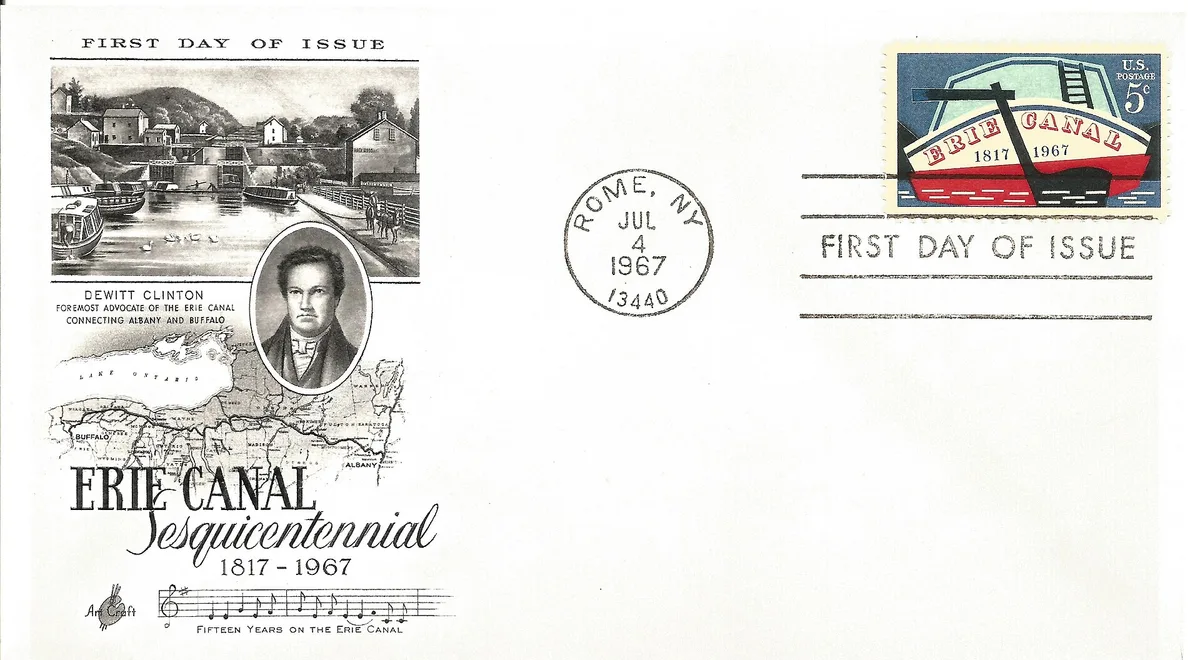
Because a canal across New York sounded absurd to serious people. In 1817 the state legislature finally approved $7 million for construction, a vast sum for a single project. Governor DeWitt Clinton took the political risk, and opponents mocked the plan as Clinton's Folly and Clinton's Big Ditch. The canal answered its critics on October 26, 1825, the day it opened. We covered a connected angle in How the Federal Art Project Painted America.
Construction was its own argument. The ditch was dug by Irish laborers and German stonemasons, working with human, animal and water power. Engineering techniques were improvised as the work went along, including aqueducts built to carry the canal over rivers.
How Did the Canal Move Freight So Cheaply?
With animal power and patience. A mule could carry about 250 pounds on its back but draw a barge weighing as much as 60,000 pounds along a towpath. Boats pulled by teams of horses moved by day and by night, cutting travel time between Albany and Buffalo nearly in half. Grain and goods now reached market at a price overland routes could not match.
Who Traveled on the Canal?
People, not just cargo. Packet boats served passengers, and migrants took passage on freight boats, camping on deck or on top of crates. The steady, nonstop method of travel turned a rough overland journey into a scheduled ride west, and it moved at all hours. The canal carried the country's expansion as surely as its grain.
How Was the Opening Celebrated?
Like a national wedding. A flotilla led by Governor DeWitt Clinton aboard the Seneca Chief sailed from Buffalo to New York City over ten days. When the boats arrived, Clinton poured Lake Erie water into New York Harbor to mark the "Wedding of the Waters." A 90-minute cannonade relayed the news along the canal and the Hudson.
How Fast Did the Canal Pay Off?
Faster than most public works ever do. Tolls collected on freight had already exceeded the state's construction debt in the canal's first year of official operation, and the initial loan for the original canal was paid by 1837. The waterway's peak year came in 1855, when 33,000 commercial shipments moved on it. Tolls survived until 1883.
What Did the Canal Do to New York City?
It gave the port an inland empire. The westward connection handed New York City a strong advantage over every other US port and brought major growth to canal cities such as Albany, Utica, Syracuse, Rochester and Buffalo. By 1828, customs duties collected at the New York Customs House were supporting federal government operations. New York became known as the Empire State.
Is the Erie Canal Still in Use?
Yes, and no waterway matches its record. The National Park Service notes that New York's canal system has been in continuous operation since 1825, longer than any other constructed transportation system in North America. Today the Erie Canalway National Heritage Corridor covers 4,834 square miles across 23 counties and is home to 3.2 million people.
Conclusion: The Ditch That Built a Market
Eight years of digging redrew the map of American commerce. A $7 million gamble opened in 1825, out-earned its construction debt within a year, lifted Buffalo and New York City together and gave a state the nickname it still wears. The Erie Canal changed America the sure way: it moved goods, and the culture followed the freight.