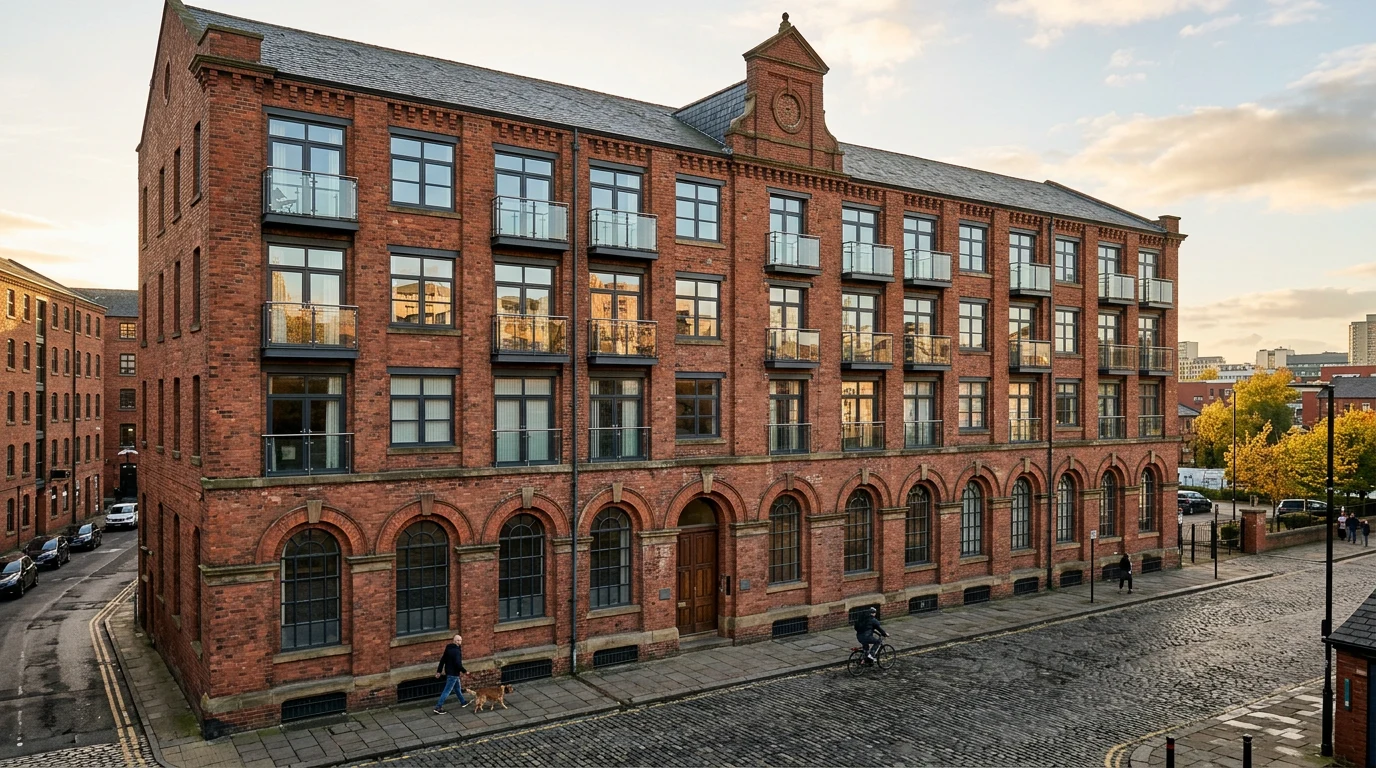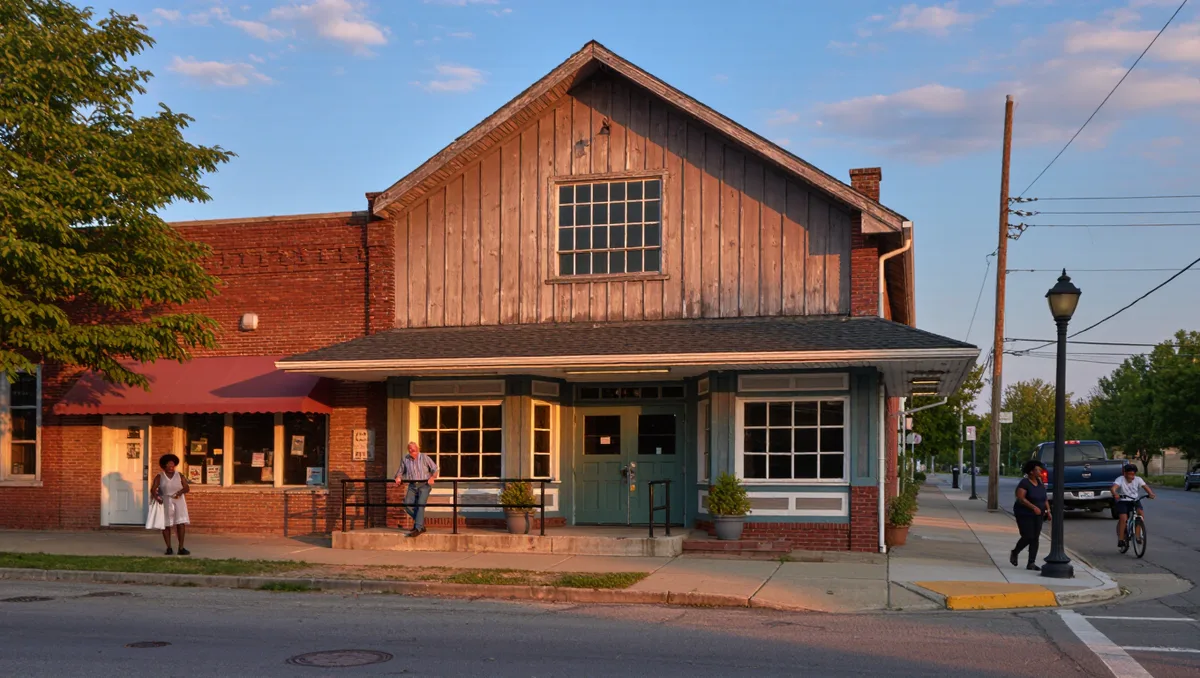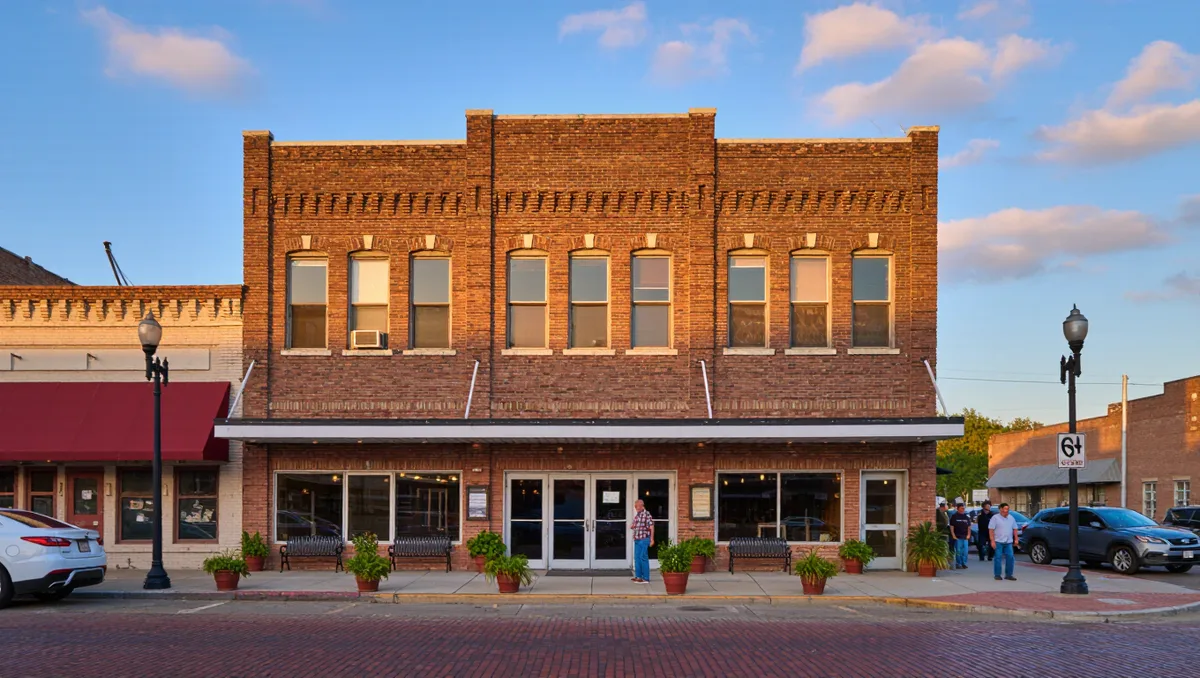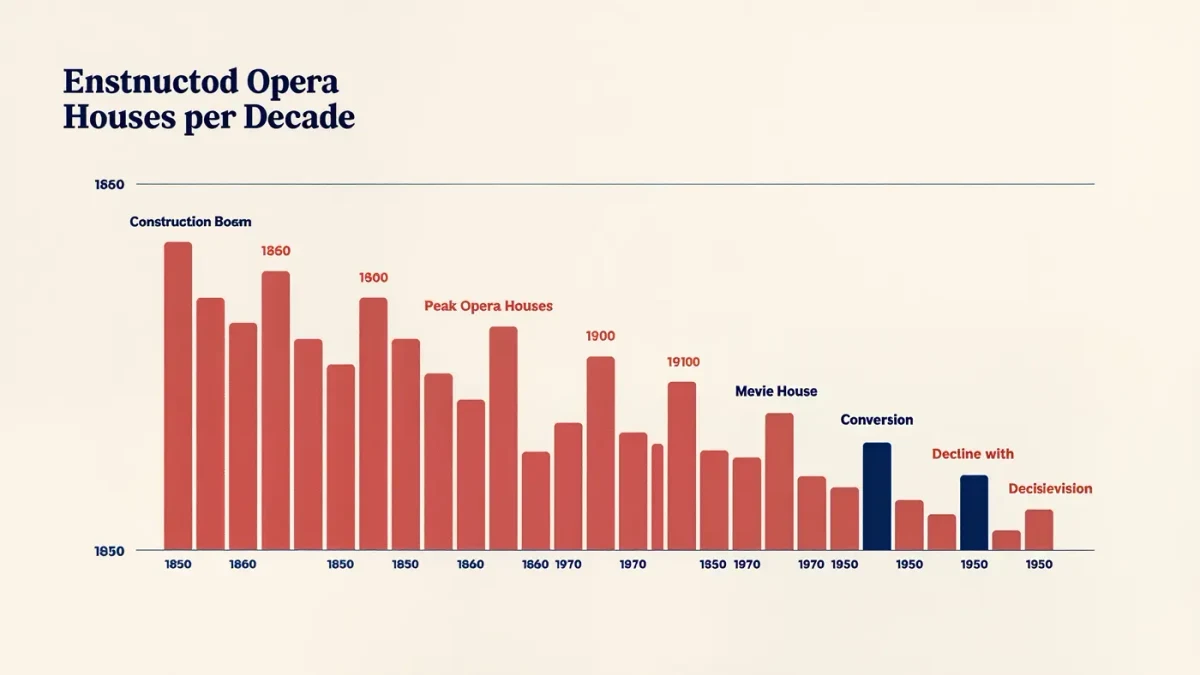
Between the 1850s and about 1910, American towns with populations of a few thousand erected several thousand buildings labeled opera house, usually on the second floor above a hardware store or a bank. Historians of nineteenth-century theater estimate that the majority of American counties had at least one by 1900, and very few of them ever hosted an opera. The name was aspirational, the programming was everything from Shakespeare to vaudeville, and the boom says a great deal about what small-town America wanted to be.
Why did tiny towns want an opera house at all?
Status, mostly, plus a genuine hunger for entertainment that radio and cinema had not yet cheapened. An opera house announced that a town had arrived: it had a railroad, a mercantile class with money to subscribe to shares, and a claim to refinement that distinguished it from the raw settlements of a generation earlier. The buildings went up fast after the Civil War, when town founding itself became a speculative industry, and the local opera house was as standard a piece of the kit as a newspaper and a courthouse square.
The economics were simpler than the name suggests. Most opera houses were mixed-use from the start: a store at street level, a lodge hall or offices above, and a stage and raked floor at the top, financed by local businessmen who took shares the way they took shares in the grain elevator. The opera house doubled as the town's assembly room for graduations, political rallies, church benefits, and masked balls, which meant it earned its keep even in weeks when no troupe came through. This practical plumbing beneath the pretension is the honest charm of the type.
What actually played in these halls?
Almost everything except opera. The touring system of the late nineteenth century moved productions along the rail lines in circuits, and a town on a circuit could expect traveling Shakespeare companies, melodramas, minstrel shows, temperance lecturers, elocutionists, magicians, opera singers on descent, and by the 1890s full road companies of New York hits. Sarah Bernhardt played the provinces, so did Edwin Booth, and so did hundreds of troupes whose names survive only in the ledger books of hall managers. Admission ran from perhaps 25 cents for gallery seats to a dollar for the parquet, a serious evening's expense for a farm family, and they paid it.
The booking system that fed these halls was its own industry. Combination companies, shipping a complete show with scenery and cast from town to town, replaced the older stock system in the 1870s and 1880s, and theatrical syndicates consolidated bookings in the 1890s to the point where a refusal to deal could starve a hall. Small-town managers kept dating books that read like weather reports: the Swiss Bell Ringers in March, Uncle Tom's Cabin with two companies in the same season, a lecture on the Holy Land with stereopticon views. The mix was cosmopolitan in content even when it was provincial in address, and it delivered the world's culture, lightly used, to Kansas and Nebraska and upstate New York.
How grand did these buildings get?
Grander than the towns sometimes. The typical small opera house held 400 to 800 people, with a horseshoe balcony, gas and later electric chandeliers, frescoed prosceniums, and a stage house tall enough to fly scenery, all compressed above a streetscape of one-story shops. Larger examples in county seats pushed past 1,000 seats and added opera boxes, a proposition that made sense only if the town's boom held. Many did not; railroad towns that lost their line, or farm towns that lost their population to the cities in the 1920s, inherited halls too expensive to heat.
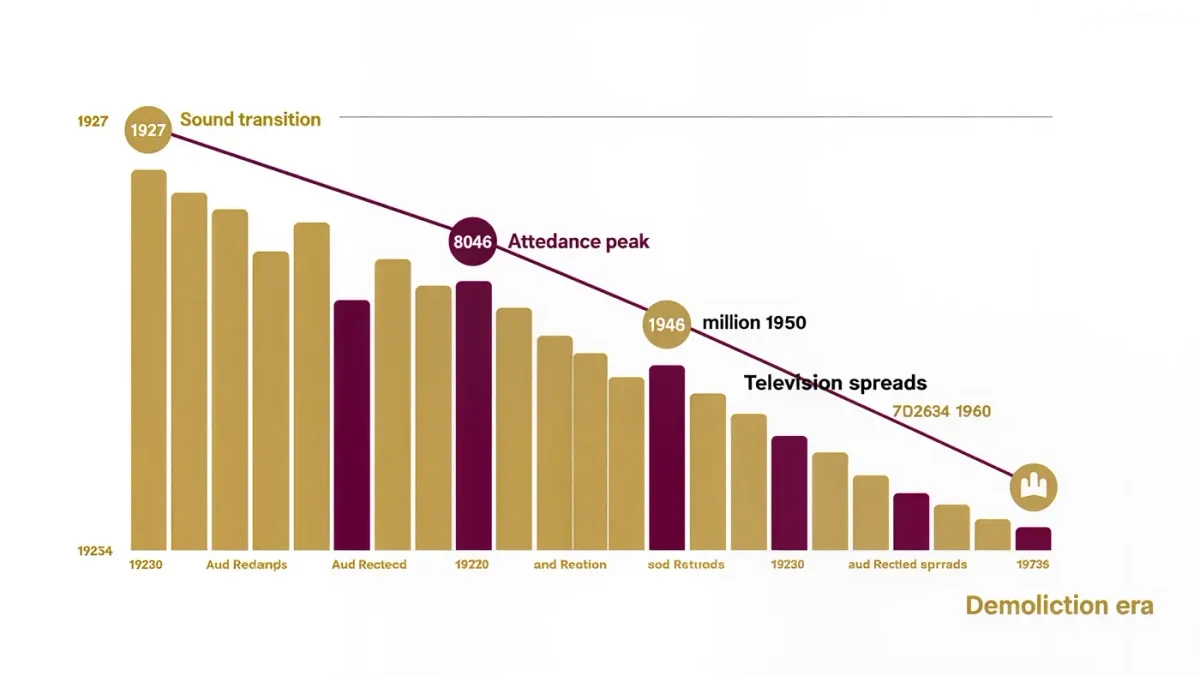
The peak of the type passed around 1900, just as the economics turned. Vaudeville chains preferred purpose-built theaters, motion pictures needed only a wall and a projector, and the Model T let audiences drive to the bigger shows in the bigger town. Many opera houses converted to movie duty in the 1910s, dropped a floor flat over the balcony seats, and kept the marquee; the fates repeated themselves when television arrived in the 1950s. By mid-century, hundreds had burned, been gutted for storage, or simply been locked, their stages intact behind rolled-up doors on Main Street.
What happened to them all?
The standard trajectory was decline, then one of three exits: demolition, adaptive reuse as a lodge hall or apartment block, or restoration. The preservation movement of the 1970s and 1980s rediscovered the type just in time for a meaningful number, and today restored nineteenth-century opera houses operate as performing arts centers in dozens of states, from the Grand Opera House in Dubuque, Iowa, which dates to 1865, to halls reopened in the 1990s and 2000s in Nebraska, Kansas, Michigan, and Vermont. The National Register of Historic Places lists hundreds of them, and state humanities councils have mapped the survivors.
What the restorations found under the water damage was often startlingly complete: hand-painted canvas drops, treadle-operated fly lofts, gas fixture stubs, and graffiti from touring companies a century old. The buildings turn out to have been too awkward to modernize, which is why so many survived intact, the architectural equivalent of a sealed cave. A restored opera house is now a standard piece of small-town economic strategy, hosting community theater and touring folk acts, an honest enough echo of the 1890s mix, though today's shareholders are more likely to be a nonprofit and a state grant than the local dry goods merchant.
Who ran the show in a town of two thousand?
Usually a local man with another job. The typical opera house manager was a drugstore owner, newspaper editor, or furniture dealer who handled bookings, heated the hall, settled with the touring company's treasurer on a guaranteed split, and pasted up the playbills, often printed by his own newspaper. Troupes arriving by rail sent an advance man a week ahead to paper the town with dodgers, and the manager's ledger decided whether a company played a return date the next season. It was a reputation economy conducted at walking speed.
The audience did its part with a formality that survives in the buildings themselves: dress circles and parquet for the respectable, a separate gallery stair for those who paid less, and, in much of the country until well into the twentieth century, segregated seating enforced as casually as the ticket prices. Programs were printed locally, and the surviving ones record an evening's running order in detail, down to the between-act songs. For many farm families, a night at the opera house was the year's most formal event, and its frescoes and chandeliers were the grandest architecture they would stand inside until a county courthouse went up.
Why should anyone outside those towns care?
Because the opera house boom is a record of what culture meant before mass media finished centralizing it. In 1890, a farm family's access to professional performance depended on a rail spur, a local shareholder with taste, and a booking agent's routing; the system was inefficient, unequal, and locally accountable in a way no streaming service will ever be. The buildings also preserve a physical history of American ambition, brick by brick, in places too small to rate a museum. And they are still the best seats in town, which was, after all, the point.