Why does landscape painting still sell America? The Hudson River School is the answer. It was the nation’s first homegrown art movement, and it turned American scenery into a national story. In 2005, Alice Walton paid $35 million for one of its landscapes, then a record price for an American painting.
That canvas was Kindred Spirits, painted in 1849 by Asher Brown Durand. It now hangs in the Crystal Bridges Museum of American Art in Bentonville, Arkansas. The movement behind it flourished from 1825 to 1870 and centered on New York City. Its painters gave the young republic a face, and the market never lost interest. For related coverage, see Folk Music Artists Who Shaped the American Sound.
What Was the Hudson River School?
The Hudson River School was a mid-19th-century art movement shaped by Romanticism. It ran no classrooms. The name covers a loose group of landscape painters who shared New York City as a base. Many kept studios in the Tenth Street Studio Building in Greenwich Village. The label arrived late, and it arrived as an insult. It first appeared in print in 1879, after the style had gone out of fashion among American collectors.
Thomas Cole is generally acknowledged as the founder. He was an English immigrant with a taste for wild scenery, and he set the terms the others followed. The group split into two waves, and the split still matters:
- The first generation painted the Hudson River Valley, the Catskills, and the White Mountains.
- The second generation rose after Cole died in 1848. Frederic Edwin Church, John Frederick Kensett, and Sanford Robinson Gifford carried the style to South America and the West, in a mode later called Luminism.
How Did Landscape Become a National Myth?
Thomas Cole took a steamboat up the Hudson in the autumn of 1825, stopped at Catskill landing, and hiked into the eastern Catskill Mountains to paint. The New York Evening Post ran the first review of his work on November 22, 1825. That date is a fair birthday for a national school of scenery.
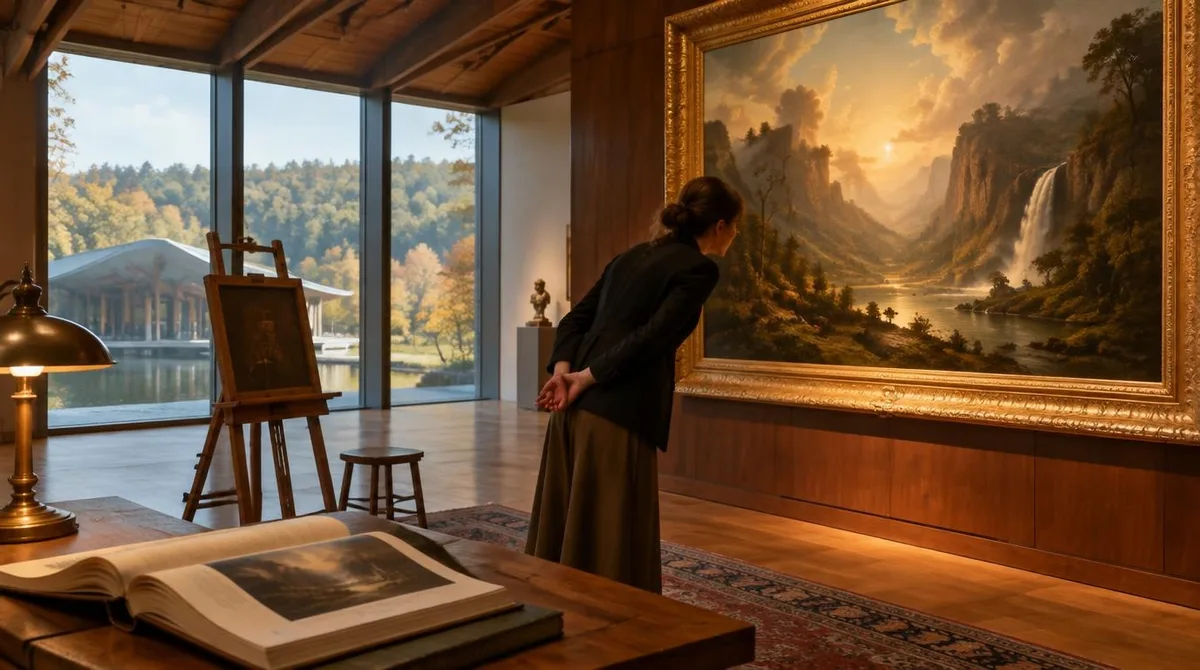
The painters saw the land as more than scenery. In their view, nature, in the form of the American landscape, was a reflection of God. Their pictures carry three themes of the century: discovery, exploration, and settlement. Many were uneasy about the factories and railroads of their age, and the canvases quietly hold that doubt. Audiences responded. Thousands paid 25 cents each to view huge paintings such as Church’s Niagara and The Icebergs. Epic landscape was popular entertainment long before cinema.
Why Do Collectors Still Pay Millions?
The clearest answer hangs in Arkansas. Kindred Spirits shows Cole and the poet William Cullen Bryant in the Catskills, and it was made as a memorial after Cole died of pleurisy in February 1848. Bryant’s daughter Julia gave it to the New York Public Library in 1904. In 2005 the library sold it at auction to Walton for $35 million, a record for a painting by an American artist at the time. Critics accused the library of jettisoning part of the city’s cultural patrimony. The library said it needed the money for its endowment. The canvas moved to Crystal Bridges, and the price set a tone other sales have followed.
Where Do These Paintings Hang Today?
The movement holds real ground in public collections. One of its largest shares sits at the Wadsworth Atheneum in Hartford, Connecticut: 13 landscapes by Thomas Cole and 11 by the Hartford native Frederic Edwin Church, personal friends of the museum’s founder. Dedicated historic sites keep the home country alive too, from the Thomas Cole National Historic Site in Catskill, declared in 1999, to Olana State Historic Site in Hudson, New York. We covered a connected angle in Who Actually Pays For The Public Library — And Why Washington Barely Does.
Attention has moved in cycles. It rose after the First World War, sank by mid-century, and grew again from the 1960s. Museums and auction houses now trade on that renewed regard, and the cycle keeps rewarding the scenery.
Conclusion: The Story Outlived the Insult
The Hudson River School still sells America because it first sold America to itself. It gave a young country scenery worth staring at, and it folded discovery, exploration, and settlement into a single image. The name began as a slight in 1879, yet the pictures outlasted the sneer. A $35 million Durand in 2005, a museum of American art in Bentonville, and the 25-cent crowds of the 1860s all tell one story. The myth holds because the market keeps agreeing to it.