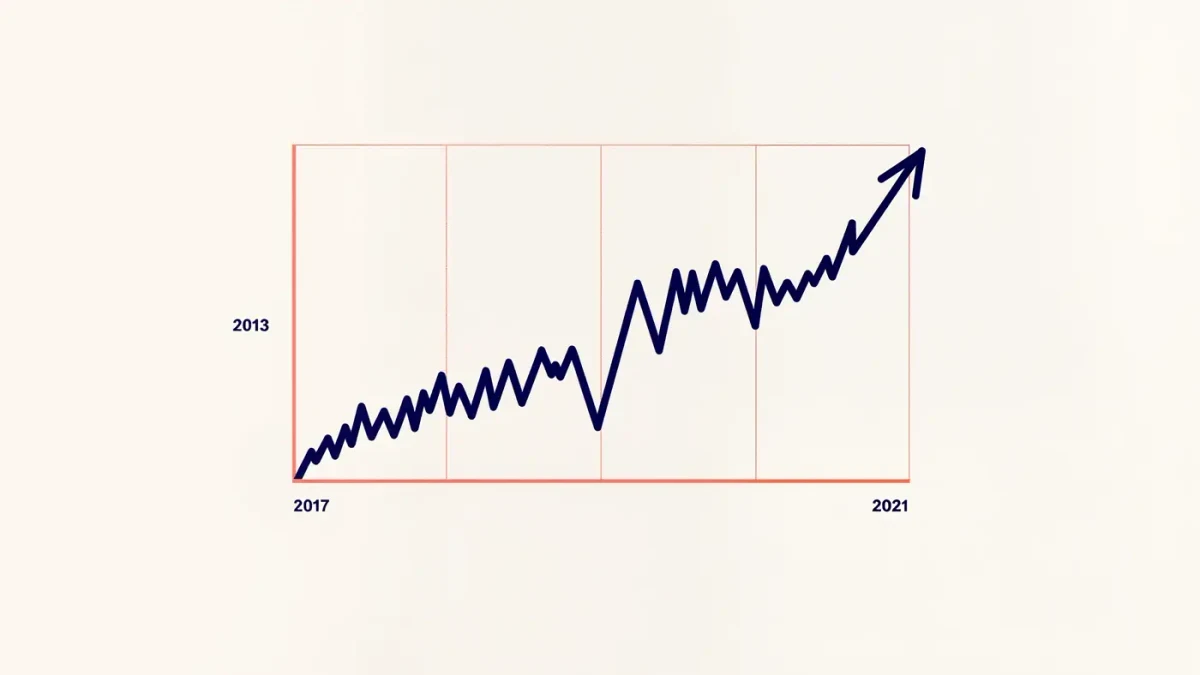
In 2017, for the first time in fifteen years, the National Endowment for the Arts recorded an increase in Americans reading poetry: nearly twelve percent of adults, about twenty-eight million people. Meanwhile industry trackers reported that poetry book sales had roughly doubled over the preceding five years, driven by young women buying slim volumes they discovered on their phones. Poetry, the art form officially pronounced dead at regular intervals since the 1950s, had quietly become one of publishing's few growth categories.
Weren't poetry sales supposed to be collapsing?
They were, and for decades the obituaries had receipts. Serious poetry collections sold in the low thousands; university presses subsidized the art; and the NEA's participation surveys showed poetry reading sliding from about seventeen percent of adults in 1992 toward single digits by 2012. The consensus explanation was structural: poetry had retreated into the academy, written mostly by professors for tenure committees, and the public had returned the favor by ignoring it.
The reversal began outside the academy entirely. Rupi Kaur, a Canadian poet of Indian descent then in her early twenties, self-published Milk and Honey in 2014, built an audience through Instagram and Tumblr, and watched the book spend years on the New York Times bestseller list, selling millions of copies in dozens of languages. The trades watched a twenty-something with a phone outsell the entire prestige apparatus of American poetry without appearing on a single syllabus. That was the moment the industry stopped treating poetry as a loss leader for literature departments.
What did social media actually change?
The unit of consumption. A poem is one of the few literary forms that fits comfortably in a phone screen without feeling amputated, and platforms built around short vertical text — Tumblr, then Instagram, then TikTok — turned the individual poem into a shareable object, the way the single replaced the album. A reader who would never browse a poetry section encounters a poem between a meme and a friend's vacation photos, with zero purchase friction and zero cultural overhead.
The aesthetic adapted in turn. Instagram-era poetry runs short, lowercase, visually spare, and emotionally direct, which its critics call simplistic and its readers call the point. What is not disputable is the commercial mechanism: Kaur and successors like Lang Leav and r.h. Sin demonstrated a reproducible path from free stanzas to paid paperback, and publishers responded with dedicated poetry imprints, while Andrews McMeel — a publisher best known for comics and calendars — became the trade's unlikely poetry powerhouse. By 2018 the trade press was reporting poetry sales growth that outpaced nearly every other category in print.
Didn't a political moment help too?
Twice. The first wave of the sales boom, 2017-2018, coincided with an American appetite for verse as protest and consolation; poets like Claudia Rankine, whose Citizen appeared in 2014, and Danez Smith found audiences well beyond poetry's traditional buyers, and anthologies of resistance verse sold accordingly. Then, in January 2021, Amanda Gorman read 'The Hill We Climb' at the presidential inauguration at twenty-two, the youngest inaugural poet in American history, and the printed edition became an instant bestseller that dominated lists for months. A single televised poem did more for poetry sales that winter than a decade of classroom assignments.
The Gorman effect confirmed something the industry had suspected since Kaur: the bottleneck was never interest; it was distribution and permission. Americans had not stopped wanting poetry. They had stopped being handed any at a moment of felt urgency, and the inauguration handed twenty million of them a poem simultaneously. Sales of her subsequent collection, Call Us What We Carry, and a wave of publisher signings of young spoken-word performers followed on the logic that the audience was real and merely under-served.
Is this real poetry or a fad with line breaks?
The honest answer is that the question is older than Instagram and has never once been settled in the art's favor or against it. The same accusation — popular, therefore dubious — attached to Rod McKuen, the best-selling poet of the late 1960s and 1970s, whose books sold millions before critical opinion buried him; to the Beat poets, whose readings drew stadium crowds in the same era; and, if you go back far enough, to Longfellow, the Victorian rock star whose 'Paul Revere's Ride' (1861) was crowd-pleasing verse in its day. The American market has always run on two parallel poetry economies, the popular and the credentialed, and every generation pretends the popular one is new.
What is genuinely new is the mixing. Today's bestseller lists seat Instagram poets beside former poet laureates — Joy Harjo, Tracey K. Smith, and before them Billy Collins, whose accessible collections were already selling hundreds of thousands of copies in the 2000s, a fact usually forgotten in the origin stories. The credential economy adapted fastest of all: MFa programs, which numbered under twenty in 1980 and over two hundred by the 2010s, supply the credentialed tier with a steady workforce, and spoken-word and Instagram success now feeds enrollment rather than embarrassing it.
What about audiobooks, slams, and the rest of the ecosystem?
The boom is not only paper. Poetry is unusually well suited to audio — it was an oral form before it was a print one — and spoken-word albums, poetry podcasts, and audiobook editions have grown with the category. The live circuit recovered with it: poetry slams, which grew out of Chicago's Green Mill readings in the 1980s under Marc Smith, now anchor a national scene of venues and competitions, and the youth slam organization founded in 1990s Chicago still sends teams to national brackets. None of this registers in BookScan, which is one reason the official sales numbers probably undercount the form's actual reach.
Libraries round out the picture. Public libraries report poetry among their most requested categories for young readers during National Poetry Month each April, an occasion the Academy of American Poets has run since 1996 and which has hardened into a genuine retail and curricular season. A form that was supposed to be dead now has a month, a hashtag, a live circuit, an audio market, and an apparel-adjacent merchandise line. Whether it also still has critics is a matter of taste.
Can the boom outlast the algorithm?
The risk is the same one that inflated the boom: platform dependency. Poetry's retail revival tracked the rise and plateau of the social platforms that carried it, and publishers who over-acquired Instagram-style verse in 2018-2019 watched the category normalize once the feed economy moved on. The durable gains look different: young readers in the habit of buying single-author books, independent presses with real poetry backlists, and a live-events circuit — slams, open mics, university series — that survived the pandemic and, by most accounts, came back stronger.
The long view argues for modesty in both directions. Poetry sales remain a rounding error next to fiction; poetry reading, even after the 2017 rebound, still serves roughly one American in nine. But the form has now demonstrated, twice in a decade, that it can behave like popular culture when given popular distribution — a fact American publishing spent sixty years declining to test. The poems fit on the phone. That, in the end, turned out to be the whole business model.