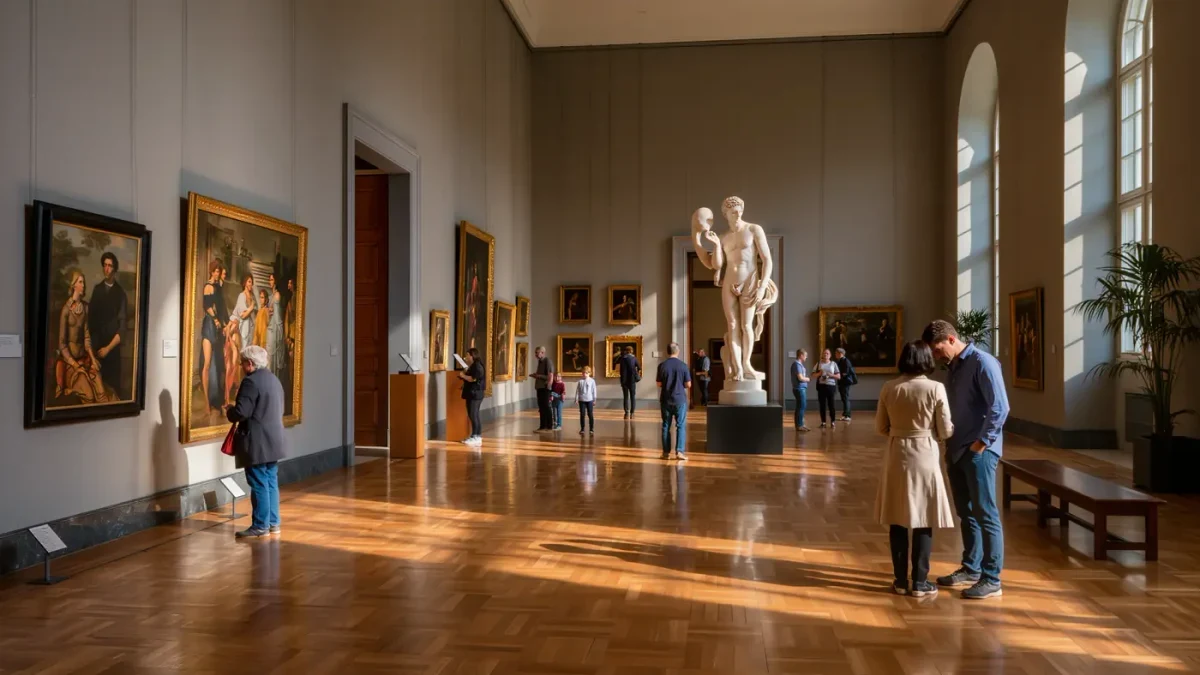
Roughly one in five American adults walked through an art museum or gallery in the survey year, according to the National Endowment for the Arts' Survey of Public Participation in the Arts, first run in 1982. That figure has barely moved in forty years. What has changed is who those visitors are, where they come from, and what they expect once the coat is checked.
Who is the typical American museum visitor?
The honest answer: an older, college-educated woman living in or near a city. The NEA's 2022 survey, the most recent large federal count, found art museum and gallery attendance hovering around 22 percent of adults, with rates climbing sharply with age past 55, education, and income. Visitors with a graduate degree attend at several times the rate of high school graduates. It is a public institution with a remarkably private audience.
This profile is not a scandal so much as a slow accumulation of habit. Museum-going in America is learned behavior, usually acquired in childhood through a school trip or a parent with a membership card. The Pew Research Center reported in 2015 that more than half of Americans had visited a history museum or historic site in the previous year, which sounds impressive until you notice the same surveys show art museums drawing a far narrower slice. History, it turns out, feels compulsory; art feels optional.
Geography does quiet work here. The Metropolitan Museum of Art alone reported well over five million visitors in fiscal 2023, and a handful of institutions — the Smithsonian's Air and Space, the Getty, the Art Institute of Chicago — absorb a disproportionate share of all American museum attendance. If you live within driving distance of one of these anchors, you are statistically a different kind of American museumgoer than someone in rural Kansas, for whom the nearest encyclopedic collection might be a six-hour drive.
Which kinds of museums draw the biggest crowds?
Not the art museums, mostly. Science centers, children's museums, historic sites, and zoos collectively out-attend fine art institutions by a wide margin, and the single most visited museum complex in the country is the Smithsonian, which charges no admission and reported more than ten million visits across its buildings in 2023 as tourism returned. Military and transportation museums, often run on volunteer labor in small towns, post steady numbers that no one in either coastal media center ever writes about.
The attendance hierarchy tells you something about how Americans actually use museums. The most popular formats are the ones a family can visit with a nine-year-old without negotiating behavior in a hushed gallery. Hands-on institutions designed for children expanded enormously from the 1980s onward, led by places like the Indianapolis Children's Museum, founded in 1925 and still among the most visited museums of any kind in the country. The quiet truth of American museum-going is that the audience is young — but only where the exhibits can be touched.
Why do attendance numbers never seem to move?
Because the base is a moving sidewalk. Roughly a quarter of adults were visiting art institutions in the early 1980s, and roughly a fifth still are. Each decade ages out a loyal generation and recruits a new one at nearly the same rate. New buildings, blockbuster shows, and free admission nights shift which institutions capture the visitors, but not how many Americans think of museums as their kind of place.
The blockbusters are worth a pause. The King Tut exhibition of 1976-1979 drew more than eight million visitors across six American cities, arguably inventing the modern museum blockbuster and proving that attendance could be extraordinary when the object was extraordinary. Since then, museums have periodically chased that high with Impressionist package tours and designer retrospectives. The pattern is consistent: a spike during the run, then a return to baseline, like a restaurant that fills whenever a celebrity chef visits.
Free admission is the other great lever, and it works about as well as you would expect. When the Baltimore Museum of Art briefly offered free general admission and doubled down on community programming in the late 2010s, it reported attendance gains, but the gains concentrated among people who were already inclined to come. Decades of research on fee waivers suggest price was rarely the first barrier; time, habit, and the sense that the place was 'not for me' ranked higher.
Did the pandemic change who shows up?
Yes and no. Attendance collapsed in 2020 — most American museums closed for months, and some, like the institutions surveyed by the American Alliance of Museums, reported losing the majority of their visitors that year. The recovery since 2021 has been real but uneven: large, tourist-anchored museums largely rebounded, while smaller and mid-sized institutions, dependent on school groups and local repeat visitors, recovered more slowly.
The pandemic's durable gift to museums was the digital audience. Virtual tours, online exhibitions, and collections databases reached people who had never set foot in the buildings, and museum educators discovered an audience with no commute. Most institutions have kept the digital front door open even as physical attendance returned. Whether that online crowd ever converts into ticket-buyers is the open question of the decade.
One quiet shift deserves attention: the domestic tourism rebound after 2021 funneled Americans into their own country's museums. Institutions in walkable city centers reported visitors behaving more like tourists — one visit, big highlights, gift shop — and less like the repeat local member of the old profile. The member model, built on monthly drop-ins, is still searching for its post-2020 footing.
What are museums doing about the audience they lack?
Mostly trying to change the product rather than the price. The past decade has brought later hours with bars, live music, yoga in sculpture courts, and exhibitions built around sneakers, hip-hop, and video games. The Brooklyn Museum's 2015 David Bowie show and later hip-hop fashion exhibitions drew crowds that looked noticeably different from the subscribers, and the strategy spread.
The harder work is slower. Community advisory groups, bilingual labels, free school transportation, and partnerships with libraries are unglamorous and take years to show results. Institutions that commit to them — the Oakland Museum of California has been a frequent case study since its 1969 founding on explicitly civic lines — tend to build audiences that better resemble their zip codes. Whether that counts as success against a dashboard built on ticket revenue is a question many boards still struggle to answer.
Does any of this settle the 'museums are elite' argument?
Partly. The attendance data does show a strong class and education skew for art museums, and no serious person disputes it. But the broader museum sector — history museums, historic sites, children's museums, science centers, zoos — reaches a much wider public, and American museums overall claim hundreds of millions of visits a year. The elite reputation attaches specifically to art institutions, which are also the ones most likely to be free, most likely to run school programs, and most likely to worry about the question in public.
The most useful framing is the oldest one. In 1906 the American Association of Museums — now the American Alliance of Museums — was founded on the claim that museums exist for the public benefit. A century of attendance data suggests the public has been selectively convinced. About a fifth of Americans treat museums as essential furniture of a cultivated life; the rest treat them as somewhere they went once on a school bus, which is either a failure of imagination or a reasonable summary of the product, depending on the museum.