An estimated five million Americans gather regularly in book clubs, and the number swells considerably if you count the ones that meet on apps. Since Reese Witherspoon founded her book club in 2017, a single celebrity endorsement can drive a novel onto bestseller lists eighteen months after its paperback sank without trace. The book club, once a parlor ritual, is now an industry with a supply chain, and the book business could not function without it.
Where did the book club come from?
American book clubs are older than the republic's reading habits are usually given credit for. Hannah Adams and other serious women readers organized reading societies in New England in the late eighteenth century, and by the 1820s women's literary societies were meeting from Salem to Lexington. These were often the only institutional venues where women could discuss ideas in public, and many evolved into libraries and reform organizations.
The commercial turn came in 1926, when Harry Scherman's Book of the Month Club began mailing curated hardcovers to a national middle class that trusted judges more than its own taste. The Literary Guild followed in 1927, and for most of the twentieth century 'book club' meant a mail-order subscription. The modern discussion circle — eight friends, a living room, two glasses of wine per chapter discussed — is largely a post-1970s invention, professionalized in the 1980s when publishers discovered that reading groups moved backlist paperbacks in quantities advertising could not.
How did celebrity clubs become the industry's marketing department?
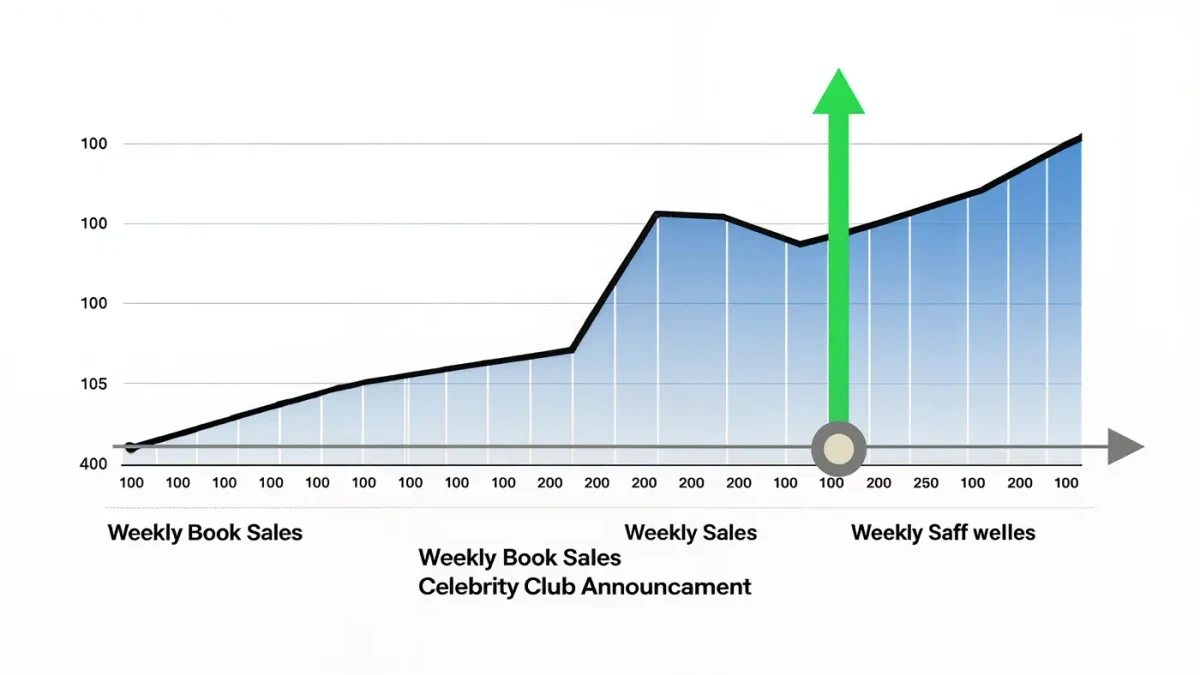
The mechanism is the pick. When a club with a large following names a title, its printing is effectively guaranteed: Reese's Book Club selections routinely jump onto the New York Times bestseller list within a week, and publisher Simon & Schuster signed a first-look publishing deal with Witherspoon's Hello Sunshine in 2016 to build a pipeline around the effect. Jenna Bush Hager's Read with Jenna picks on NBC's Today show have produced similar instant bestsellers since 2019.
What the celebrity club sells is not a book but a membership card in a mass conversation. The novel arrives pre-loaded with discussion questions, an author interview, and a hashtag, which removes the one task that killed more book clubs than any argument about endings: choosing. Publishers noticed and began acquiring what the trade calls 'book club fiction' as a genre — domestic suspense, dual-timeline historical novels, and books whose protagonists have exactly one secret. The genre is real enough that Barnes & Noble now builds tables around it.
What did BookTok change?
Scale and direction. BookTok — the reading community on TikTok — inverted the pipeline: instead of a publisher persuading a tastemaker, an anonymous reader's tearful fifty-second video persuades millions. Older romances and dark academia titles returned as bestsellers years after publication; Colleen Hoover's backlist, originally published in the 2010s, dominated the New York Times fiction list through 2022 and 2023 on the strength of entirely reader-made momentum. Publishers responded by printing 'BookTok favorite' stickers on covers, a rare instance of marketing copying customers rather than the reverse.
The anomaly that made this visible on Main Street was Barnes & Noble's recovery. After James Daunt took over the chain in 2019, he gave store managers latitude to hand-sell local favorites instead of obeying corporate tables — essentially recreating the book recommendation as a neighborhood service. Through 2023 and 2024 the chain reported its best results in years and opened new stores for the first time in over a decade, with Daunt crediting BookTok-driven demand among younger readers. The irony is standard for American culture: the oldest retail format in the category turned out to be the beneficiary of the newest one.
Is any of this getting people to read?
Marginally, and mostly fiction. The NEA's Survey of Public Participation in the Arts recorded about 37 percent of adults reading a novel or short story in 2022, down several points from a decade earlier — a long, gentle decline that book clubs and BookTok have slowed at the edges without reversing. What the clubs demonstrably do is concentrate buying: they move specific titles in bulk, create hardcover sales for genres that used to go straight to paperback, and keep backlists alive.
They also change how books are written, which is the part worth watching. The reliable book club novel is structured for discussion — an ethical dilemma with two defensible sides, a reveal positioned exactly at the meeting's midpoint, an ending ambiguous enough to fill twenty minutes of argument. Authors now openly discuss writing for clubs the way screenwriters once wrote for the water cooler. A form designed to slow reading down is quietly shaping what gets fast-tracked through it.
Why are most book club members women?
Because the institutions that taught reading as a social act were built by and for women, and nothing has displaced them. The parlor societies of the nineteenth century were among the few acceptable public intellectual venues for women; the twentieth-century reading circle followed women into the suburbs, where it functioned as both culture and childcare-adjacent survival; and the current celebrity era was designed, without embarrassment, for a female audience. When men join, they tend to form clubs modeled on something else — a sports bar with paragraphs — and the books skew toward war, business, and Hemingway.
Publishers have noticed the composition and adjusted their covers accordingly, which produces its own quiet distortions. Serious novels by women are packaged to look like book club novels, with soft typographies and shorelines, while some male readers report avoiding exactly those covers. The club audience is large enough to shape an entire shelf of American fiction, and it shapes what is invisible there too.
Has the internet replaced the living room?
It has multiplied it. Alongside the celebrity clubs sits an archipelago of digital communities — Goodreads groups founded in the 2000s, Instagram's Bookstagram aesthetic scene, Reddit's massive reading forums, and subscription clubs that ship a surprise hardcover monthly. The digital versions solve the living room's chronic problems: scheduling, that one member who dominates, the drive home. What they give up is the food, the obligation, and the specific social pressure that makes a person finish a four-hundred-page novel she would otherwise abandon at page ninety.
The hybrid future appears to be winning. Apps like Fable and the platforms built around serialized reading have added group features, while libraries — quietly the largest book club operators in the country — have run in-person and virtual clubs for decades without any of it trending. The public library does monthly what the industry celebrates annually, at a price no subscription box can match, which is the industry's most carefully unexamined fact.
Who profits from all this talking?
The platform sits in the middle and takes a cut of both ends. Book clubs organized through subscription boxes and apps — the boom in paid book subscription services dates to the mid-2010s — charge monthly fees for curation that libraries perform free. Publishers get a predictable marketing channel; celebrity curators get equity stakes and production pipelines; bookstores get foot traffic with a purchase attached. The reader gets a community, a deadline, and the peculiar accountability of having promised six strangers she would finish chapter nine.
Whether that constitutes a literary culture is a fair question with an unfashionable answer. The parlor societies of the 1820s were also mocked as social occasions with books attached, and they incubated abolitionist organizing and half the public libraries in New England. The current version incubates bestseller lists. Culture's instruments have done worse, and the wine, at least, has improved.