The first drive-in theater opened on June 6, 1933, in Camden, New Jersey, where chemical plant manager Richard Hollingshead charged 25 cents per car and 25 cents per person to watch a movie from folding chairs and cars arranged on ramps he had tested in his own driveway. The idea multiplied slowly through the Depression, exploded after the war, and peaked at more than 4,000 outdoor screens in the late 1950s, a figure that has since fallen to roughly 300 in the United States.
Whose idea was the drive-in, really?
Hollingshead gets the patent, and the patent is a good story: in 1932 he experimented in his driveway with a 1928 Kodak projector mounted on the hood of his car, a screen between trees, and a sprinkler-sprayed block of wood to test how rain beat on a car roof. His 1933 Camden opening, with RCA sound equipment and space for about 400 cars, was promoted as entertainment for the whole family regardless of means, an angle aimed squarely at mothers with small children who could not sit through indoor programs.
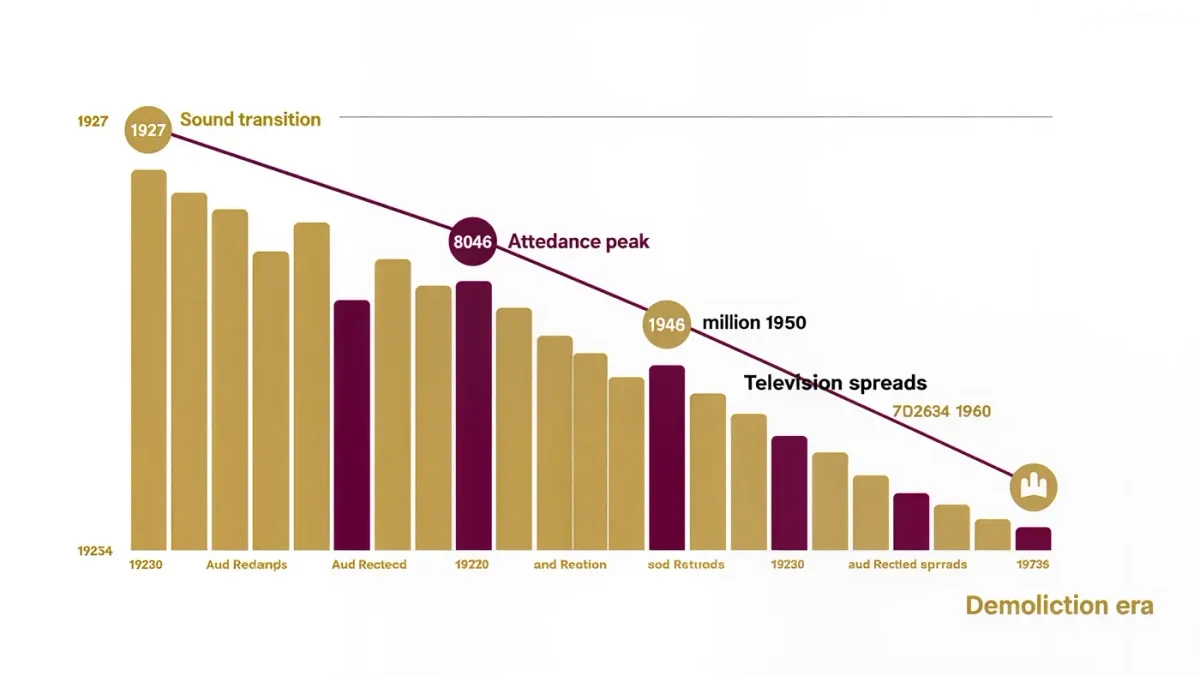
He was not working from nothing. Outdoor movie screenings predated him, and other inventors, including a Texas tradition of outdoor picture shows, contested the concept's origins. Hollingshead's patent was eventually voided in 1950 after litigation from a New York operator, which arrived just in time: freed of licensing fees at the start of the baby boom, the industry entered its great expansion. From roughly 100 drive-ins in 1945, the count passed 800 by 1948, 2,000 by 1950, and passed 4,000 by 1958, spread along the new suburban ring where land was cheap and nearly everyone had just bought a car.
What made the 1950s the drive-in's decade?
Demographics and acreage. The postwar marriage-and-baby boom created an audience of young families with cars, cash, and children who could be parked in pajamas in the back seat; suburbanization created the cheap perimeter land a 15-to-30-acre screen lot required; and teenage car culture created the customers for the second feature. Drive-ins billed themselves as complete evening destinations, with playgrounds under the screen, diaper-changing stations and bottle-warmers in the concession stand, and sometimes laundromats, animal shows, and churches using the lot on Sunday mornings.
The economics were unlike indoor exhibition. Land, a screen tower, a projection booth, and rows of speaker posts cost far less per seat than a downtown palace, and the season ran roughly from spring to fall in most of the country. Programming leaned to whatever drew cars: westerns, horror, and the teenage double features that gave the venues a reputation indoor exhibitors happily amplified. That reputation, the passion pit smear, coexisted with the family-oriented reality of most lots, which made their money at the concession stand, where popcorn, burgers, and soda could out-earn the box office after the film distributors took their cut.
What was actually inside the drive-in experience?
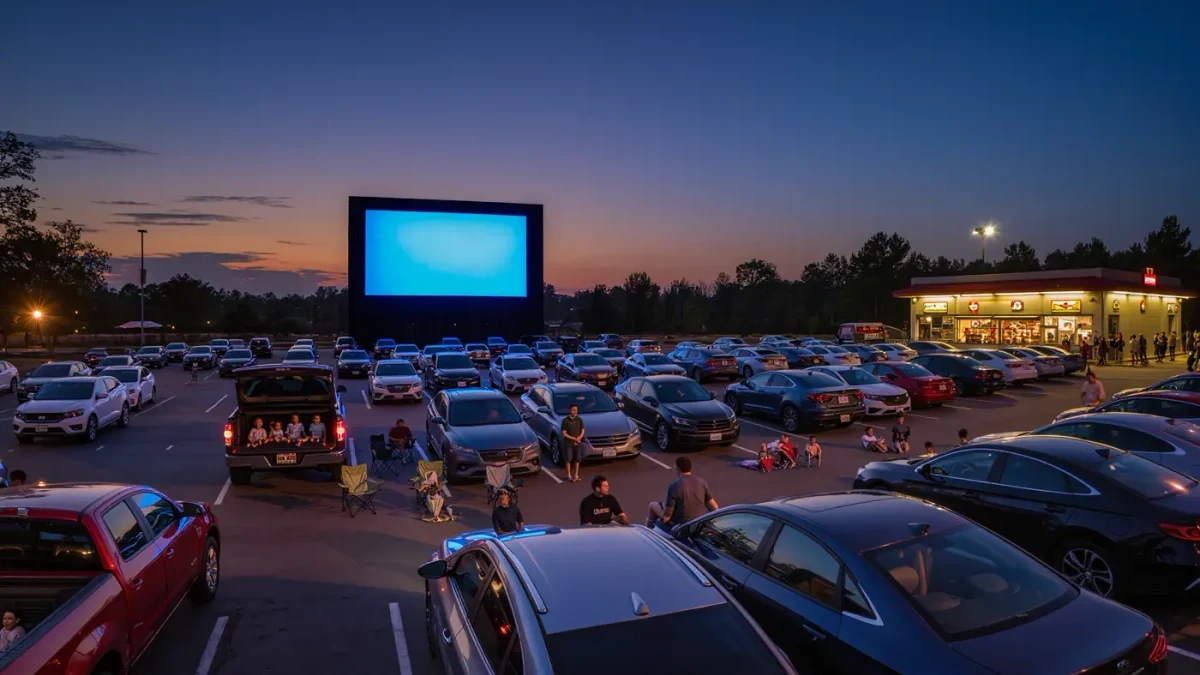
A small city with a fence around it. The classic lot surrounded its ramps with playground equipment below the screen, a miniature railroad or pony rides at the bigger venues, a blocky modernist concession stand at the back of the middle, and a speaker post every car length, from which hung a square metal speaker you hooked over the partly lowered window. Intermission films, cartoons with dancing popcorn boxes ordering the audience to the snack bar in sing-along countdowns, became a genre of their own, rediscovered by collectors decades later.
The economics of the snack bar explain the whole operation. Film rentals typically took a large share of gate receipts in the first weeks of a run, but food sales were pure margin, so the menu grew ambitious: pizza, fried chicken, barbecue, and breakfast for all-night marathons at some lots. Owners learned the traffic patterns of their crowds the way farmers read weather, stocking for the family trade on weekend early shows and the teenager trade after ten. The speaker itself was the format's weakest organ, a mediocre transistor radio in a steel case, forgotten on hundreds of thousands of window ledges and driven away mangled, which is why FM transmission eventually replaced the entire post-and-wire infrastructure without anyone mourning it.
What went wrong?
Almost everything, gradually, then simultaneously. The audience suburbanized right past the drive-ins: as the 1960s and 1970s rolled on, the cheap perimeter land the theaters occupied became shopping-center and subdivision gold, and the tax burden rose to match. Cars changed, with smaller, quieter imports and air conditioning that made rolled-up windows preferable to a tin speaker hooked on the window. The 1970s energy crises and the industry's turn to daytime schedules under the 1974 nationwide adoption of daylight saving time, which pushed late shows uncomfortably late, cut attendance further. Video rentals in the 1980s removed the last habit: by 1990 the count had fallen under 1,000, and the surviving screens became predominantly second-run and repertory venues.
The decline was also a business-model squeeze rather than pure audience loss. Drive-ins operated maybe 120 nights a year in northern states, against an indoor theater's 365, while carrying real estate that appreciated into a liability. Many owners made the rational choice and sold to developers; the archetypal American drive-in death was not bankruptcy but a closing sale followed by a strip mall. A late-1980s vogue for retrofitting indoor multiplexes onto drive-in lots, and the FM-radio sound that replaced window speakers, slowed the bleed without stopping it.
Who survived, and why?
Institutions with paid-off land and stubborn owners. The roughly 300 drive-ins operating in the United States today are disproportionately family-run, several generations deep, sitting on acreage bought decades ago, and increasingly protected by their communities; some states and preservation groups have helped with landmark designations and screen reconstructions. FM radio sound, digital projection paid for in part by a wave of crowdfunding after the 2013-2015 industry conversion deadline killed 35mm distribution, and the 2020 pandemic, when drive-ins were briefly among the only legal venues for movies, concerts, and church services, each bought the survivors time.
The 2020 revival made the drive-in momentarily fashionable as a genuinely distanced public space, a throwback that turned out to be futuristic. Attendance settled back afterward, but a handful of new lots opened, and the survivors report steady business built on the same formula Hollingshead advertised in 1933: two movies, one price per car, and the freedom to talk, eat, and let the children fall asleep. The speaker posts are mostly gone, the films arrive by hard drive, and the popcorn margin still pays the electric bill.
Are drive-ins gone everywhere else?
No, though the United States remains the format's heartland. Australia and Germany maintained drive-in circuits of their own, and new outdoor car-cinema operations have popped up in many countries, often as pop-ups rather than permanent ramps. The American count, from over 4,000 at the 1958 peak to roughly 300 today, is the number to remember, because it measures how thoroughly a format can dominate an evening's habits for a generation and then leave almost nothing but ramp-shaped shadows on aerial photographs, visible on mapping services across the country where the screen towers used to stand. Preservationists document them anyway, and a drive-in on a warm night in August remains one of the few public places where the twentieth century can still be visited for the price of a carload ticket.