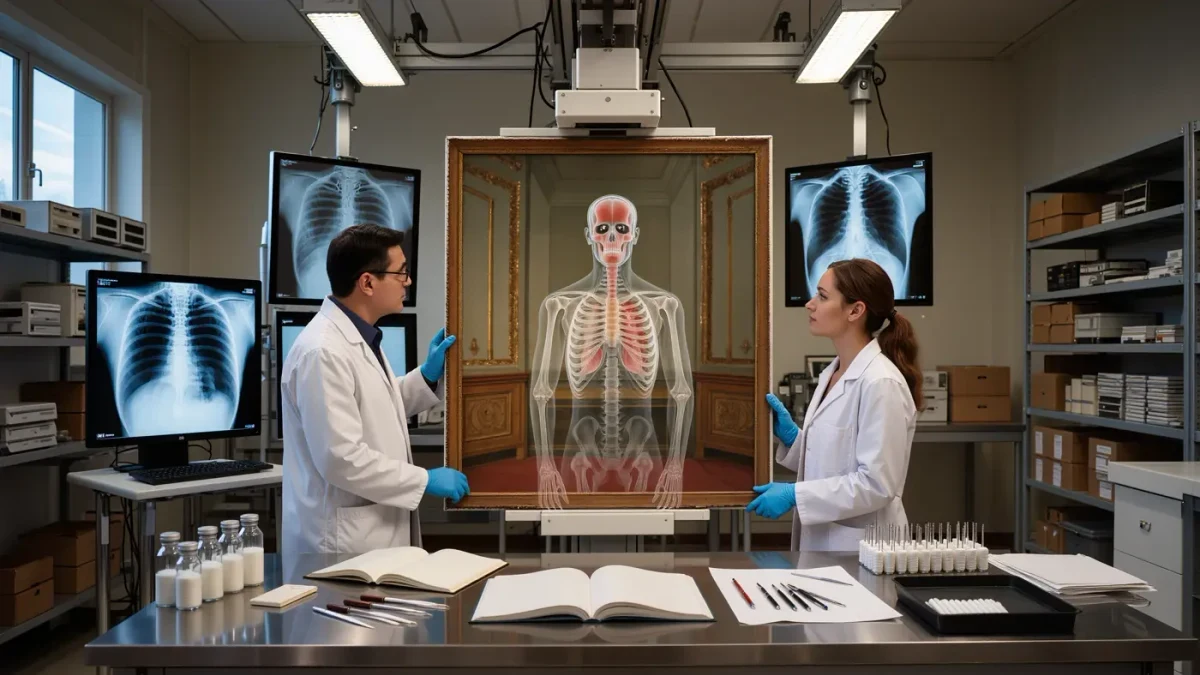
When a painting arrives at a conservation lab with an uncertain birth certificate, the first instrument of authority is not connoisseurship but radiography. X-radiography, standard in museums for a century, reveals the painting's hidden skeleton: earlier compositions beneath the surface, alterations by the artist's own hand, canvas tacks, repairs, and the ghostly brushwork density that distinguishes a buildup of lead white from a modern improvisation. Dating a painting — or exposing one — is applied science layered over art history, and the science keeps getting sharper.
What can an X-ray actually tell you?
Several things a forger cannot easily fake. Pigments absorb X-rays according to their atomic weight, so heavy pigments like lead white show up dense and light ones nearly vanish, exposing the structural order in which the painting was built. Beneath many Old Masters lie abandoned first ideas — pentimenti — and their presence, style, and placement support or undermine an attribution, because a copyist working from a finished picture has no reason to have struggled. X-rays also show the canvas weave, the nails or tacks used to stretch it, and old repairs, each of which can be compared against documented workshop practice of a claimed period. A painting said to be from 1650 but stretched on machine-made canvas from the 1880s has a problem no signature can fix.
How does tree-ring dating work on paintings?
Through dendrochronology, applied to panel paintings. Most European paintings before roughly 1600 were painted on oak boards cut from individual trees whose growth rings record the climate of each year. A dendrochronologist measures the ring sequence in a panel and matches it against master chronologies built from dated wood of the same region. Because the sapwood-to-heartwood boundary and the number of missing outer rings can be estimated, the method yields a felling date, and therefore the earliest possible date the panel could have been painted — usually within a decade or two. If the tree was felled in 1620, a painting attributed to 1510 is finished as an argument. The limitation is geographic: the method works best for Baltic oak, common in Dutch and Flemish painting, and depends on intact end-grain and complete ring sequences.
What does pigment analysis reveal?
The chemistry of color is a timeline. Synthetic pigments have documented invention dates: Prussian blue around 1704, cobalt blue in 1802, chrome yellow in the early nineteenth century, titanium white in the twentieth. A pigment identified before its invention or absent after its obsolescence is evidence of the strongest kind — material anachronism. Analysis is done with techniques with alphabet-soup names: X-ray fluorescence (XRF) for elemental composition, Raman spectroscopy for molecular structure, cross-section microscopy of tiny samples embedded in resin, and gas chromatography–mass spectrometry for binding media and later varnishes. Each answers a different question, and together they can date a painting's materials to ranges measured in decades.
The classic cautionary examples come from the forger's side. Han van Meegeren, who sold fake Vermeers to Nazi leadership in the 1940s, was undone partly by his materials: investigators found phthalocyanine pigments and early synthetic resins in works supposedly from the seventeenth century. The analysis, coupled with his own demonstration painting, converted a charge of collaboration into a charge of fraud — a rare case where pigment chemistry made international news.
What about canvas, ground, and stretcher evidence?
Supporting details carry the quiet verdicts. Canvas weave densities and thread counts changed with loom technology; the ground layer — the priming between canvas and paint — used chalk and glue in some centuries, lead white and oil in others; stretchers, nails, and tacks are datable hardware. Conservators also examine craquelure patterns, which form differently in naturally aged paint than in artificially cracked forgeries, and ultraviolet and infrared imaging, which expose later retouching and underdrawing respectively. Underdrawing — the artist's sketch beneath the paint, visible in infrared — can be compared with a workshop's documented habits, a particular discipline's draftsmanship, or its absence.
So can science prove who painted a picture?
It cannot. Science dates materials and exposes anachronisms; it does not identify hands. A painting can contain only period-correct materials and still be by a follower, a later hand, or a talented nephew. Attribution remains a synthesis — connoisseurship, provenance research, and technical study together — and the honest conclusion of much technical analysis is a range: consistent with, not identical to. What the science has changed is the burden of proof. The eye can be seduced; the cross-section cannot. When a museum quietly re-labels a painting 'Follower of' or 'Workshop of,' it is usually not a scandal being admitted but a laboratory report being obeyed.
What is infrared reflectography?
A gentle imaging technique that sees beneath the paint. Many pigments are partially transparent to infrared radiation, while carbon-based underdrawing absorbs it, so an infrared camera can record the artist's preliminary sketch hiding under the finished surface. The result is a map of the workshop's first thoughts — compositional changes, copied cartoons, or the confident freehand of a master against the careful tracing of an assistant. Infrared reflectography helped define the modern study of Netherlandish painting, where underdrawing habits differ measurably between hands, and it is now a standing tool whenever a workshop attribution is in question.