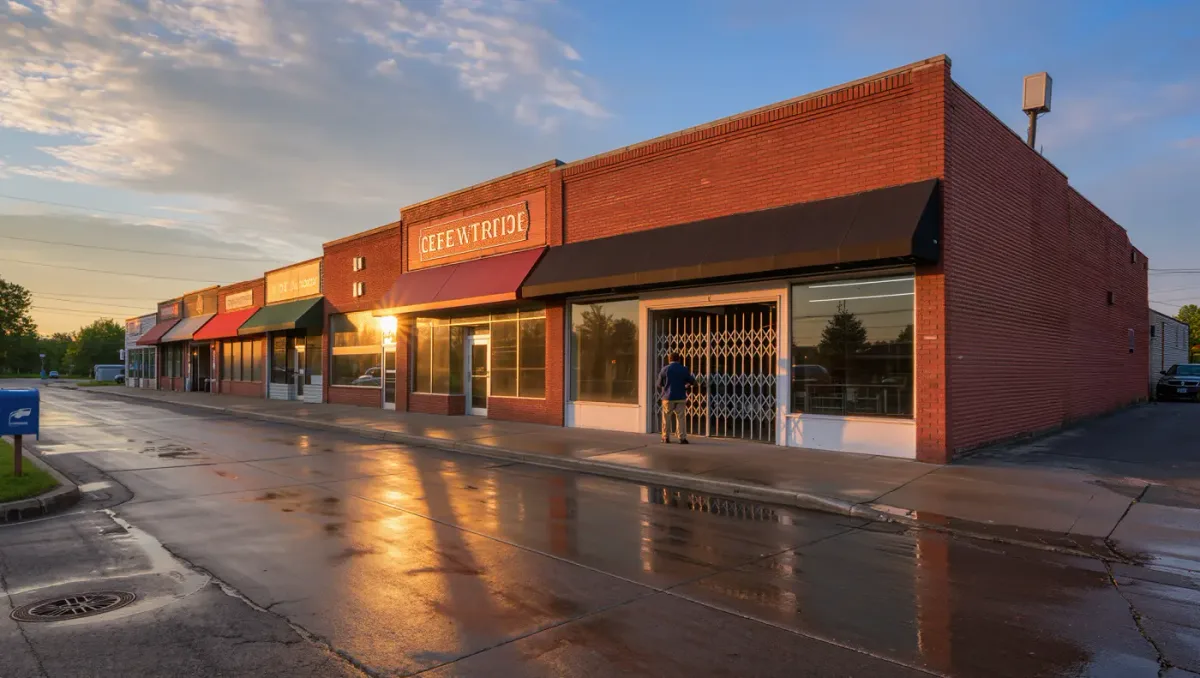
Since 1980, the Main Street America movement has tracked more than one hundred billion dollars reinvested in historic commercial districts across roughly three thousand communities, and after years of decline the trend line has turned. Empty storefronts that survived the big-box era are becoming bakeries, bookshops, and apartments again. The American Main Street, pronounced dead by every decade since the 1950s, is staging one of the least flashy comebacks in the country's cultural history.
What exactly is Main Street America?
It is a program, not a metaphor. Main Street America grew out of the National Trust for Historic Preservation and was formalized in 1980 as a framework for reviving historic downtowns through design, economic restructuring, promotion, and organization. Its affiliated communities, spread across more than forty states, apply a shared playbook: keep the old buildings, fill the ground floors, and coordinate locally. It is slow, unglamorous work measured in facade grants and upper-floor conversions rather than ribbon cuttings.
The program's origins lie in a panic. In the 1970s, preservationists watched as interstate highways, regional malls, and strip development hollowed out the downtowns that had defined American small-town life since the nineteenth century. The National Trust's three-year pilot in three Midwestern towns, launched in 1977, suggested that preservation could be an economic strategy rather than a sentimental one. That pilot became a national network, and the network became the closest thing America has to a Ministry of Main Streets.
Critics have long noted the movement's limits. It tends to celebrate incremental wins, and its statistics, compiled from local self-reporting, invite generosity. But the cumulative picture is real: thousands of districts with functioning storefront economies that would otherwise be parking lots, and a body of evidence that old buildings, properly financed, outperform their reputation.
Why did Main Streets empty out in the first place?
The short answer is that America redesigned itself around the car and the discount. Interstates bypassed downtowns in the 1950s and 1960s, suburban malls captured the shopping dollars that followed the housing, and by the 1980s Walmart and other big-box chains could underprice a Main Street hardware store on nearly every item. Each blow was rational on its own; together they compounded. A department store closes, foot traffic falls, the jeweler leaves, and the building owner's best offer comes from a thrift chain or nobody at all.
Then the bank problem. Small-town commercial lending contracted as regional banks merged into nationals in the 1990s, and a two-story brick building with a sloping floor suddenly looked like a liability. Deferred maintenance did what deferred maintenance does. By the 2000s, the typical struggling Main Street had a courthouse, three churches, a pharmacy, and a row of plywood.
What changed to bring them back?
Several pressures reversed at once, and none of them required anyone to love brick. Remote work, normalized after 2020, moved a measurable slice of city dwellers to smaller places, and those newcomers wanted coffee, gyms, and places to spend an evening within walking distance. Federal pandemic-era support, including programs that funneled money into state historic tax credit deals, made rehabilitation pencils math out that had failed for decades. And the twenty-five percent federal historic rehabilitation tax credit, expanded under the 2017 tax law, quietly became one of the most effective downtown-revival instruments the government runs.
Demographics helped. Americans in their late twenties and thirties kept showing, in survey after survey, a preference for walkable neighborhoods over cul-de-sacs, and housing costs in large metros pushed the preference into practice. A Main Street apartment above a bakery is no longer the compromise option; in many towns it is the newly scarce one. Developers noticed, and upper floors that stored restaurant napkins for forty years started converting to one-bedrooms.
Is the revival actually economic or just aesthetic?
Both, and the honest accounting separates them. The economics show up in occupancy: affiliated Main Street programs report thousands of net new businesses and jobs in their cumulative tallies, and independent analyses of historic districts find property and rent values rising faster than in comparable non-designated areas. The aesthetics matter economically, because the stock of irreplaceable nineteenth-century storefronts is exactly what a Main Street has that a highway strip does not. Distinctiveness is the product.
But there is a real critique, and it is not new. Revival can mean a cheese shop where the pharmacy used to be, serving visitors rather than residents. The most durable programs treat this as a design problem: mixed uses, housing above stores, and basic services protected as anchors. The towns that fail are the ones that turn the downtown into a seasonal stage set. The ones that succeed treat a grocery store as proudly as a taproom.
Which towns are doing this well?
The pattern repeats enough to be recognizable. Paducah, Kentucky, famously offered nearly free historic houses in its lowertown arts district to attract residents willing to renovate, a program running since 2000. Enterprise, Oregon, and other rural western towns rebuilt grocery anchors to keep districts alive. In the Mississippi Delta, small programs patch together grants one facade at a time. None of these made national news individually, which is rather the point: the movement's gains arrive distributed, in towns of two thousand people, rather than concentrated in a single celebrated turnaround that reporters can visit.
What does a revived Main Street look like on a Tuesday?
Not a festival. The reliable signs are weekday signals: a bakery open at seven, a hardware store that survives, kids walking to the library after school, second-floor curtains. Main Street practitioners have a phrase for it, the economic restructuring instinct, filling gaps in the retail mix, an alterations tailor before a second antique store. It is telling that the movement's internal metrics weigh building permits and business openings far above event attendance, because events are easy and permanence is not.
There is also a civic layer that resists measurement. Downtowns are the last places in many counties where people of genuinely different incomes and politics stand in the same line. Sociologists have documented that routine encounters in shared commercial space build the informal trust that formal institutions struggle to manufacture. A functioning Main Street is infrastructure for that, which is one reason its decline was felt as something more than economic loss, and its return as something more than gain.
Could the comeback stall?
It could, and the threats are named. Construction and borrowing costs spiked after 2022, and rehabilitation is capital-hungry work; a delayed roof can undo five years of momentum. Small-town housing shortages, ironically worsened by newcomer demand, price out the workers who staff the revived storefronts. National retail habits keep drifting online. And program funding at the state level oscillates with budgets, which is how earlier revival cycles in the 1980s and 1990s fizzled into what critics called painted-facade urban renewal.
The structural case, though, is stronger than in any previous cycle, because the demand is residential and cultural rather than retail-driven. People moved to these towns before the boutiques arrived, and they stay for reasons the highway strip cannot copy. Historic building stock, walkability, and a public identity are fixed assets. The American Main Street has been left for dead so many times that skepticism is the safe position, but the safe position has been wrong for several years running now, and the second floors keep filling in.