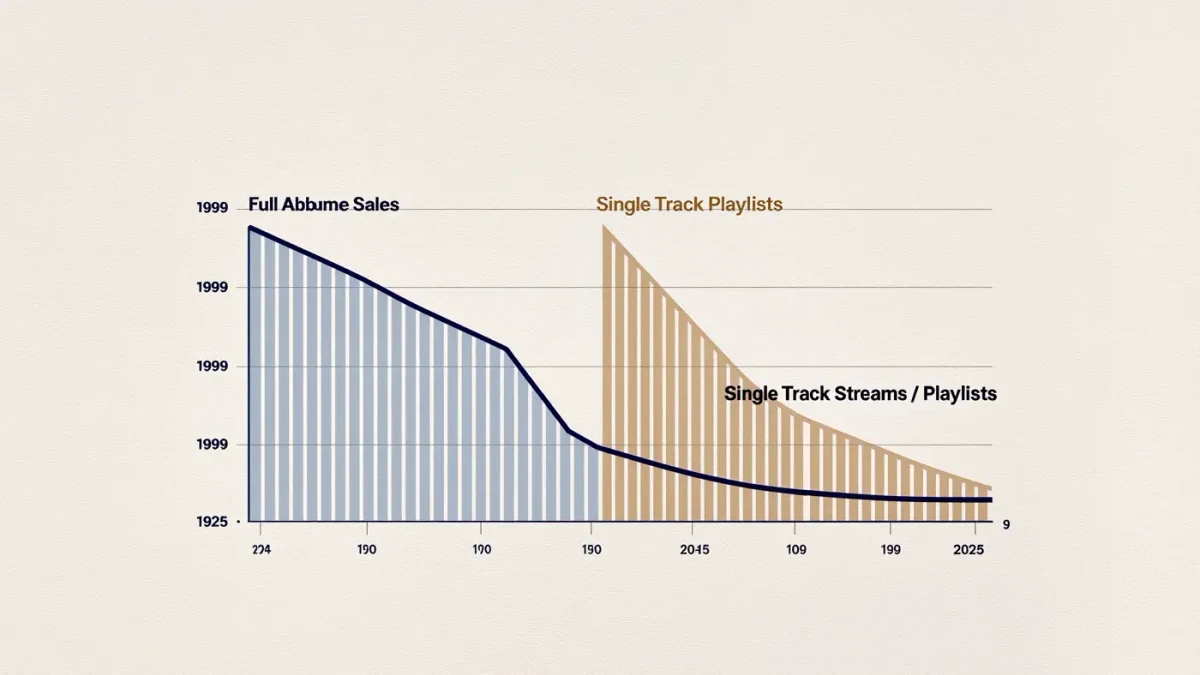
The album is not dead, but it has been demoted. In 2016, playlists overtook albums as the dominant unit of consumption on Spotify in several major markets, and by the mid-2020s Billboard's own year-end data showed catalog tracks and single-song releases driving most American listening. The twelve-song statement of purpose that defined American popular music from roughly 1965 to 2005 has become one option among many — a choice artists must now justify, rather than the default shape of a career.
Why was the album the default in the first place?
Economics, then art. The vinyl LP arrived in 1948, Columbia Records' answer to format limits, and for its first fifteen years it was mostly a container: one or two hits padded with filler. The Beatles' "Sgt. Pepper's Lonely Hearts Club Band" in 1967 is the conventional tipping point when pop artists began treating the album as a unified work — sequencing, recurring motifs, a cover worth staring at. Bob Dylan had already made the case with run-on bursts of creativity in the mid-1960s, and by the 1970s the album was the unit of ambition in nearly every American genre: prog, soul, country, jazz-rock.
The CD, introduced in 1982, supercharged the format by making albums longer and more profitable — discs cost less to manufacture than vinyl but sold for more, and the 1990s boom in catalog reissues turned the album into a permanent revenue asset. That is the part worth remembering: the album's golden age was also a business model. Listeners bought ten songs to own two, and the industry called that arrangement art for roughly forty years.
How did streaming change the unit of listening?
Streaming unbundled the album and then rebundled the songs around the listener instead of the artist. When Spotify launched in the United States in 2011 and Apple Music followed in 2015, the economic unit shrank from the album to the stream — a single play worth a fraction of a cent. Under that math, a great song earns the same whether it sits inside a masterpiece album or a throwaway playlist, and a skipped song earns almost nothing. The incentive structure now punishes the deep cut, the slow build, the track that only makes sense in sequence.
Playlists did the rest. Editorial playlists such as RapCaviar and Today's Top Hits, and algorithmic feeds like Discover Weekly, assemble songs by mood and context, not by artist or era. The listener who streams "Chill Vibes" for four hours consumes perhaps sixty songs without once learning an album's name. Even the retrospective logic changed: a young listener meeting Pink Floyd through a "classic rock road trip" playlist experiences "The Dark Side of the Moon" the way a 1958 teenager experienced 45 rpm singles — one song at a time, severed from its sequence.
How are artists adapting to song-by-song economics?
Adaptation has taken several visible forms. Shorter albums are one: as the streaming era matured, many major releases settled at eight to ten tracks, partly artistic restraint and partly a royalty arithmetic in which every skip lowers a track's standing in the algorithm. Conversely, some acts pad albums with skits and interludes to farm per-track plays, and a few notorious cases have released dozens of near-silent or minute-long tracks to game stream counts. The single-first pipeline is now standard: songs are released individually, tested against algorithms, and only later gathered into an "album" that functions more like a season finale than a statement.
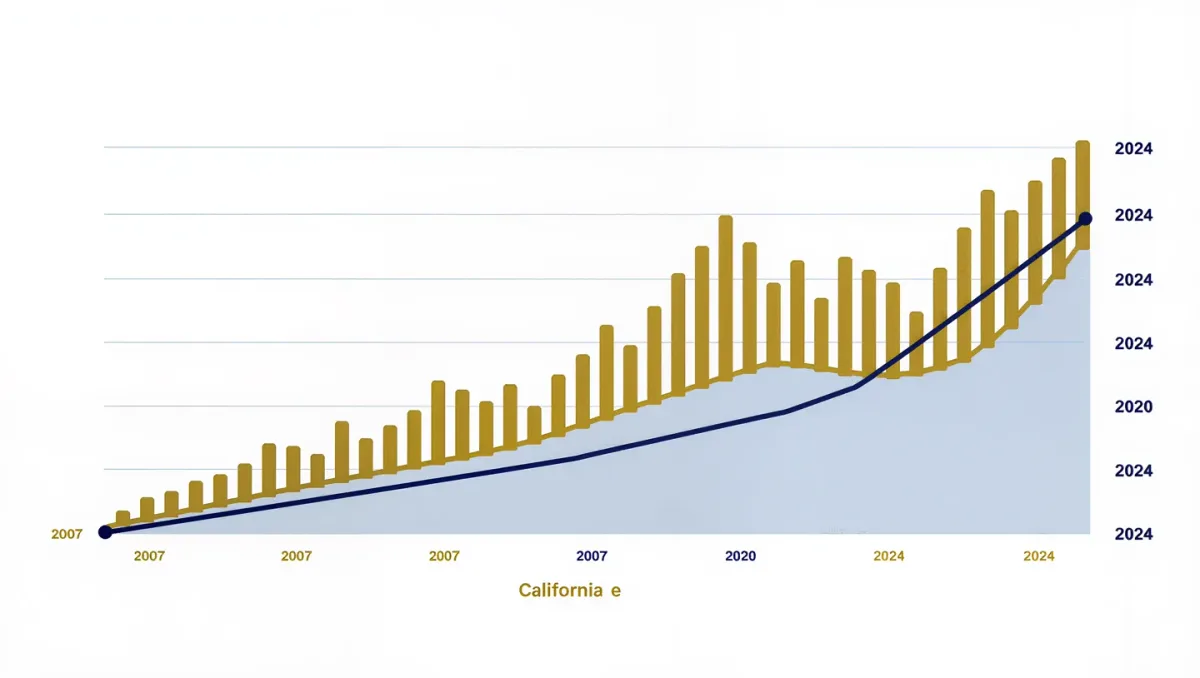
There is also the workaround economy. Vinyl sales, after collapsing to near zero in the 2000s, grew for roughly seventeen consecutive years in the US through 2024, outselling CDs again — and vinyl buyers overwhelmingly want full albums, because the format itself argues for sitting still. Deluxe editions, variant covers, and regional exclusives have turned the album into a collectible object for the committed fan, even as casual listening goes playlist-shaped. The album survives as merch, souvenir, and artifact.
Does anyone still make real albums?
Yes, and the defense deserves a straight presentation. The 2020s have produced a run of genuinely album-scale American works that audiences treated as albums — Kendrick Lamar's "Mr. Morale & the Big Steppers" in 2022, Beyoncé's genre-straddling "Act" projects, Taylor Swift's rerecordings, which function as arguments about authorship that only make sense at album length. Swift's "The Tortured Poets Department" in 2024 moved massive physical units, 31 tracks long, an artifact twice the length of a classic LP. The album, its defenders argue, was never merely a format; it was a container for sustained attention, and sustained attention has not vanished from American culture. It has just become a choice.
The honest counterpoint to the nostalgia: most albums were never "Sgt. Pepper." The filler problem predates streaming by half a century, and listeners' willingness to skip bad songs is not a civilizational loss but a consumer convenience. What actually changed is that the album can no longer compel attention by default; it must earn it against a feed that is infinitely longer and better personalized.
Is the album's decline bad for music?
It is bad for one specific thing and neutral for others. The specific loss is sequence-dependent art — the album that rearranges your expectations across forty minutes, from "Pet Sounds" to "To Pimp a Butterfly." That form requires a listener contract that streaming economics quietly voids. What is not lost: songcraft, which the single era rewards handsomely; discovery, which algorithms do better than radio ever did; and archives, since streaming makes nearly a century of American recording available instantly, an access achievement the LP era never approached.
The most likely long-term picture is a split culture. A commercial mainstream organized around songs, snippets, and virality — the TikTok-to-chart pipeline that broke hits like "Old Town Road" in 2019 — and a parallel album culture of vinyl buyers, dedicated listeners, and prestige releases, smaller than before but economically real and artistically deliberate. The album will not recover its monopoly. It may recover its meaning, precisely because choosing it now means something.
What comes after the album?
Early signals point to the project, not the product: rolling releases, deluxe expansions, songs that mutate across versions, albums treated as software with updates rather than objects with release dates. The industry's own metrics are adapting too — Billboard began weighting streams toward subscription-tier plays and adjusting how catalog sales count, small admissions that the old units of measurement no longer describe how Americans actually listen. What will not return is the world where an album was the only way to be a serious artist. The format that gave American music its greatest sustained statements was born of a business model, sustained by it, and finally outlived it. What remains is whatever artists can do with forty minutes of a listener's willing time — which, it turns out, is still quite a lot.