Most Americans will never set foot in a building designed by a celebrity architect, but nearly all of them live in one designed by nobody in particular. Roughly four in five American buildings are standard commercial or residential stock — strip malls, tract houses, branch banks, school additions — shaped by zoning codes, cost schedules, and habit rather than by any signature style. The country argues endlessly about its handful of icons and spends almost no time thinking about the 80 percent that actually constitutes the built environment. That mismatch is worth correcting.
What is wrong with celebrating great buildings?
Nothing is wrong with celebrating them, and the best of them earn it. The trouble is what the celebration displaces. When "architecture" means Frank Gehry's Guggenheim Bilbao or the latest twisting tower by a brand-name firm, everything else becomes invisible — and invisible things do not get maintained, improved, or defended. The United States added roughly 100 million people between 1970 and 2020, and the overwhelming majority of that growth was housed, schooled, and shopped in deliberately unremarkable buildings. A culture that only knows how to discuss cathedrals has nothing to say about the parish.
There is also a measurement problem. Iconic buildings are usually one-off performances: custom budgets, patient clients, structural heroics that do not translate. A museum whose steel was value-engineered into feasibility is not a model for the elementary school a county needs by August. Praising starchitecture as if it were a scalable practice is like recommending gala catering to a school-lunch program. The techniques that produce the icon are precisely the techniques ordinary construction cannot afford.
Why does ordinary building get such bad press?
Partly because critics are paid to notice exceptions, and partly because the ordinary of the recent past was genuinely bad for a while. The post-1970 era of American construction produced much to answer for: parking-first downtowns, vinyl subdivisions built for speed, big-box corridors that aged badly, and office parks designed around cars rather than people. The architecture of default became a synonym for the architecture of decline, and the reasonable reaction — "we deserve better than this" — hardened into the assumption that better means extraordinary.
The historical record complicates that assumption. The most beloved ordinary streetscapes in America — Brooklyn brownstones, Charleston single houses, pre-war Main Streets, bungalow districts from Pasadena to Chicago — were all, at the time they were built, ordinary. They were developer products, pattern-book houses, and speculative construction, executed with a competence so routine that nobody thought to sign them. Nobody celebrates Carroll Gardens because a genius designed each row house. They celebrate it because thousands of adequate, similar, well-proportioned buildings accumulated into a good place. Ordinary architecture is not the opposite of the beloved city. It is the raw material of it.
What does ordinary architecture do well?
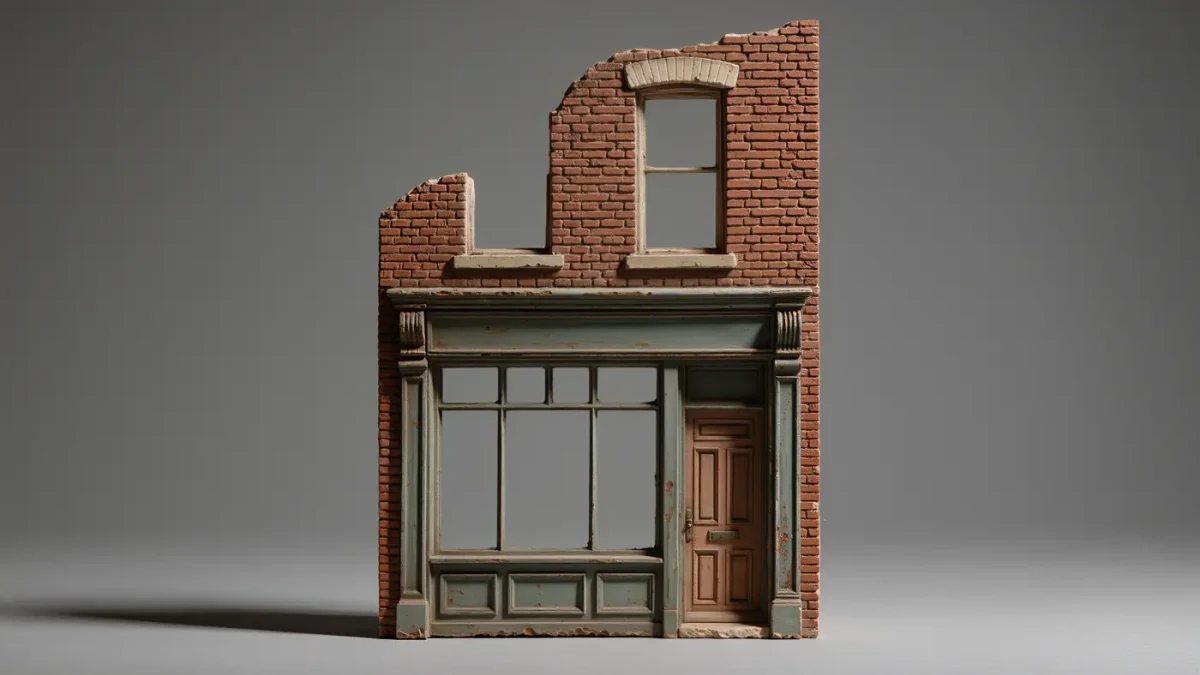
Its virtues are unglamorous and measurable. It is repeatable, which means errors get corrected across thousands of instances rather than discovered once at enormous cost. It is legible — people understand a gable roof, a shopfront, a porch, without signage or orientation. It ages into contexts: a street of similar buildings tolerates change better than a street of competing sculptures, because no single alteration ruins a composition that was never a composition. And it is affordable by definition, since its whole method is the disciplined refusal of custom solutions where a standard one will serve.
The strongest argument, though, is civic. Ordinary buildings are where the infrastructure of daily life happens: the pharmacy that becomes a voting place, the diner that becomes a landmark by surviving, the library branch that holds the line on a changing block. Jane Jacobs made this case for streets in 1961, arguing that new ideas need old buildings because old buildings charge cheap rent. The same logic favors plain buildings: they are loose containers, easy to repurpose, undemanding of their tenants' identity. An extraordinary building is a bespoke suit. An ordinary one is a good coat that fits whoever shows up.
Don't cities need ambition and icons too?
The fair answer is yes, and the strongest version of that case deserves a hearing. Defenders of ambitious architecture argue that cities compete globally for talent and investment, and that landmark buildings — the "Bilbao effect," named after the Spanish museum credited with reviving that city after 1997 — deliver brand value no streetscape can. They note that yesterday's ordinary is not automatically tomorrow's charm: plenty of cheap construction from the 1960s and 1970s was demolished without regret, and some of it deserved it. And they worry, reasonably, that a culture of modest expectations becomes an excuse for mediocrity, that developers will happily build the cheapest adequate thing forever if nobody demands more.
These objections land. But they argue for ambition in the public realm — libraries, transit, parks, civic buildings where boldness serves everyone — rather than for the privatized spectacle of the trophy tower. The dichotomy is not bold versus bland. It is between design effort spent where many people will live with it, and design effort spent where a photographer will stand.
How could the United States build ordinary buildings better?
The encouraging part is how much of this is a matter of rules rather than genius. Form-based codes, which regulate building shape and street relationship instead of use, have produced well-liked ordinary districts in cities from Miami to Buffalo. Missing-middle housing — duplexes, fourplexes, small apartment buildings that look like large houses — lets ordinary types deliver density without spectacle. The Congress for the New Urbanism has spent three decades assembling this playbook, and its findings are stubbornly unheroic: build to the sidewalk, put a door on the street, use materials that age gracefully, repeat.
There is even a fiscal case. Analysts of urban finance, following work popularized by the organization Urban3, have shown that per-acre productivity of plain two-story Main Street blocks routinely exceeds that of vast single-story developments, once infrastructure costs are counted honestly. The ordinary building, it turns out, is often the one paying the city's bills — one more argument for treating it not as a failure of imagination but as the actual American architecture, deserving of the same serious attention the icons receive. The country's next great streetscape will not be designed. It will be repeated.