Two American world's fairs did disproportionate cultural damage: the World's Columbian Exposition in Chicago, which ran from May to October 1893 and drew about 27.5 million visitors, and the New York World's Fair of 1939 and 1940, which drew roughly 44 million across its two seasons. Between them they taught Americans what a city should look like and what the future should contain, lessons the country absorbed so thoroughly that the syllabus is now invisible.
What was so important about Chicago in 1893?
Scale, whiteness, and electric light. The Columbian Exposition, staged on reclaimed marshland in Jackson Park to mark the 400th anniversary of Columbus's voyage, put up a temporary city of some 200 buildings in white neoclassical stucco, organized by Daniel Burnham and designed by the era's leading architects under Beaux-Arts discipline. At night the White City, illuminated by tens of thousands of electric lamps at a time when much of rural America still read by kerosene, made a case for electrified urban civilization that no lecture could match. Visitors who saw it went home and demanded city planning, boulevards, and white marble from their aldermen.
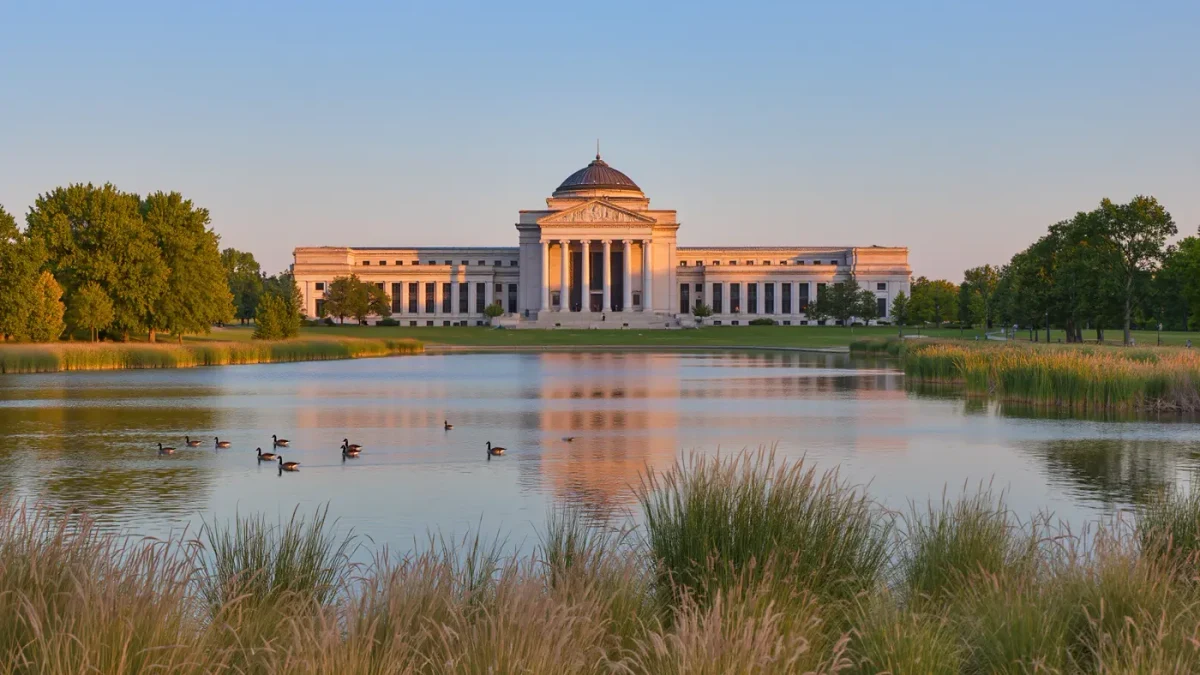
The fair's inventions outlived its architecture. George Ferris built his 264-foot wheel as an answer to the Eiffel Tower and carried some 2,160 riders at a time; the Midway Plaisance, the fair's entertainment strip, gave English the word midway for every carnival since; Cracker Jack, Juicy Fruit, Cream of Wheat, and the hamburger all advanced their claims there; Milton Bradley, the postcard craze, and the Pledge of Allegiance's first national recitation for schools trace to the grounds. The intellectual afterlife was heavier: Frederick Jackson Turner delivered his frontier thesis at a fair historians' meeting, and the City Beautiful movement, which rebuilt civic centers from Washington to San Francisco, was a direct product of what architects saw in Jackson Park. The only major survivor on site, the Palace of Fine Arts, was recast in stone and survives as the Museum of Science and Industry, still standing in the park.
How dark was the White City?
Darker than its stucco. The fair opened in the middle of a financial panic, was built with segregated labor practices and largely excluded Black Americans from its official representation, with Frederick Douglass and Ida B. Wells protesting from the grounds with a pamphlet in 1893. The Midway displayed people from Africa, Asia, and the Middle East in ethnological exhibits that presented them as living specimens, the standard practice of the era's anthropology and a lesson in hierarchy that the fair taught as confidently as it taught electrification. The fair ended its season with the city's mayor assassinated in his home by a disappointed office seeker, and a serial killer, H. H. Holmes, had operated a block or two from the grounds, though his legend has since been inflated well past his documented crimes.
Honesty about all this does not cancel the fair's influence; it explains the shape of that influence. The 1893 exposition offered a beautiful city that was also a managed, classified, top-down one, and American civic life spent the next century living with both halves of the inheritance. The White City's descendants include Carnegie libraries, union stations, and the National Mall; the Midway's descendants include every midway, and the ideas that put people in it took much longer to discredit.
What did New York 1939 promise instead?
A tomorrow, delivered on schedule. The 1939 fair, built on the ash dumps of Flushing Meadows in Queens, opened on April 30, 1939, the 150th anniversary of Washington's inauguration, with a theme officially titled Building the World of Tomorrow. Its symbols were the Trylon, a 700-foot spire, and the Perisphere, a 200-foot globe housing Democracity, a model of an idealized metropolitan region. Where Chicago looked back to Rome, New York looked forward to 1960: highways, suburbs, glass, and appliances, rendered in a streamlined moderne that still reads as the future's official uniform.
The demonstrations became the decade's most efficient prophecy. General Motors' Futurama, designed by Norman Bel Geddes, carried visitors on moving chairs over a vast model of America in 1960, cross-cut by 14-lane expressways, and is generally blamed for the interstate-highway vision that followed. RCA demonstrated television to the mass public at the fair's opening day, when Franklin Roosevelt became the first president to appear on TV. Electro the smoking robot, touch screens in the form of the Voder speech machine, fluorescent lighting, air conditioning at scale, and early television broadcasting all debuted or reached their first mass audiences there. By the fair's second season in 1940, war had begun in Europe, and the World of Tomorrow read less like a prediction than a plea.
Why did these two fairs matter more than the others?
Timing and totality. Dozens of American expositions bracketed them, from Philadelphia 1876 to San Francisco 1915 and Seattle 1962, and each left its residue. But Chicago 1893 arrived at the moment American cities were deciding their permanent form, and New York 1939 arrived at the moment technology was about to define the postwar home. Each fair functioned as a national briefing: a controlled environment where tens of millions of citizens encountered electrification, or the highway, or television, years before daily life supplied them. The attendance figures did the work; no magazine or newsreel could reach a quarter of the population in six months the way a fair could reach it in person.
The comparison also charts a change in what Americans wanted from the future. Chicago's promise was civic order, beauty conferred by experts, a city as a monument. New York's promise was consumer comfort, a future purchased by the household, the corporation as its patron. The country ended up with both: Burnham's Washington Mall and Bel Geddes' interstates, the museum and the driveway, frequently in collision. The fairs remain the clearest single archives of American expectation, which is why their souvenirs, postcards, and viewbooks are collector's items a century later.
Who paid for all this, and what did it cost?
Chicago's fair cost roughly $27 million in private capital, stock sales, and city-backed bonds, and gate receipts came close to covering it before the panic-dampened closing weeks; the philanthropic barons who bought its paintings afterward effectively founded the Art Institute's collections and the Field Museum. New York 1939 was a riskier proposition: financed by some $67 million in bonds and corporate pavilion leases, it lost money in 1939, and only a reorganized 1940 season, with new exhibits and discount promotions, brought the total attendance to about 44 million and the ledgers close to break-even.
The corporate pavilions were the tell. In 1893, manufacturers showed products; in 1939, corporations showed futures, and the fair's most popular attractions were sponsored by General Motors, Westinghouse, AT&T, and du Pont, companies that had concluded that the best advertisement was a preview. The nation's image of the future became, to a degree Americans rarely paused to notice, a deliverable of its largest firms, a pattern that carried straight through the century's concept cars, kitchen-of-tomorrow exhibits, and technology keynotes.
What remains at the sites today?
More than you would expect from temporary cities. In Chicago, the Museum of Science and Industry occupies the rebuilt Palace of Fine Arts in Jackson Park, and Wooded Island and the lagoon preserve much of Frederick Law Olmsted's grounds plan. In Queens, Flushing Meadows Corona Park keeps the fair's street plan, the restored Unisphere from the 1964 fair, the Queens Museum in the 1939 New York City Building (which hosted the United Nations General Assembly from 1946 to 1950), and the Hall of Science. Both parks host millions of visitors a year who use the grounds of the futures without knowing the briefs that produced them, which is roughly how the fairs intended it.