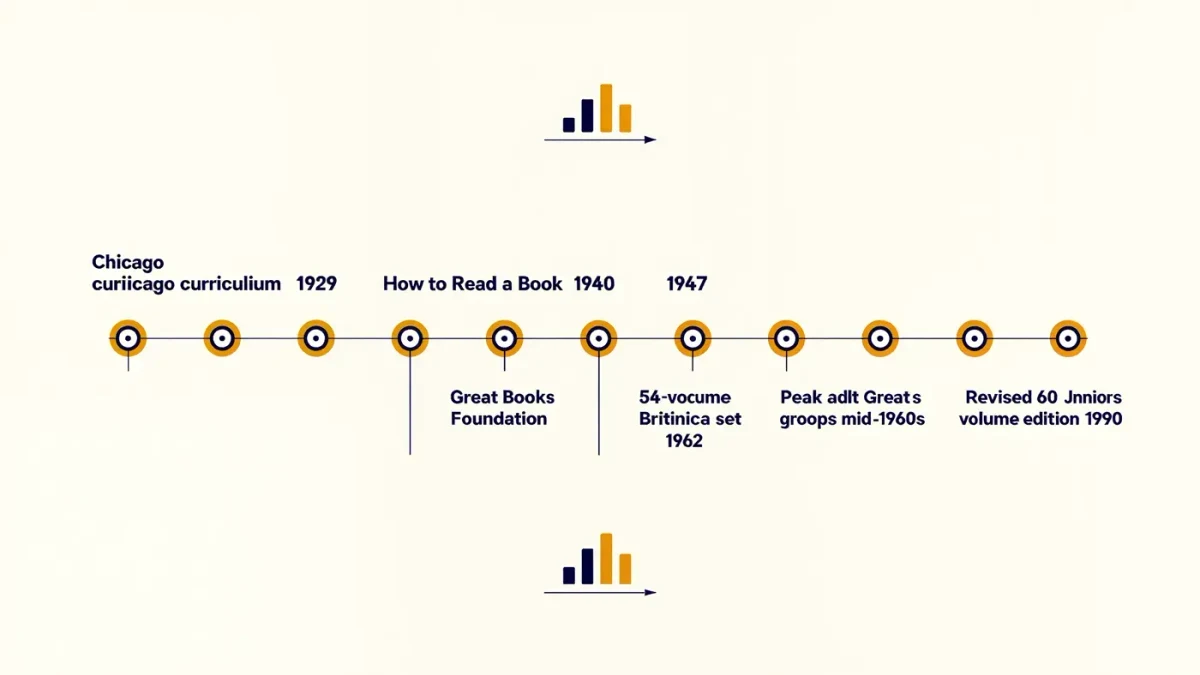
In April 1952, Encyclopaedia Britannica published Great Books of the Western World, a 54-volume set of 443 works by 74 authors, priced at $249.50 and sold door to door by the same sales force that moved encyclopedias. Behind it stood University of Chicago president Robert Maynard Hutchins and philosopher Mortimer Adler, whose Great Books curriculum and discussion groups had grown, by the mid-1960s, into a national adult education movement claiming tens of thousands of regular participants. Then, within a decade, the whole apparatus looked like a museum piece.
Where did the Great Books idea come from?
From a curriculum fight at the University of Chicago. Hutchins became Chicago's president in 1929 at age 30 and spent the 1930s dismantling its departmental structure in favor of a general education organized around reading primary texts, from Homer and Plato through Aquinas to Darwin and Freud, taught by faculty across disciplines in seminars. Mortimer Adler, hired to run the program's reading instruction, supplied the method: slow, interrogative reading aimed at understanding arguments rather than acquiring facts, later popularized in his 1940 manual How to Read a Book.
The idea had American precedents, among them Columbia's Humanities course, begun in 1919, and St. John's College in Annapolis, which adopted an all-Great-Books curriculum in 1937. What distinguished the Chicago version was ambition and a sales channel. Hutchins believed the modern research university had abandoned the question of what an educated person should know, and that the answer was a canon of works that had proven durable enough to be called great. Critics inside and outside the university called the scheme reactionary then and have been arguing about it ever since, but in the 1930s the controversy mostly sold tickets to faculty debates.
How did a curriculum become a door-to-door product?
Through Walter Paepcke, a Chicago industrialist who ran the Container Corporation, funded the university's interests, and in 1950 founded the Aspen Institute for Humanistic Studies, where executives gathered to discuss Great Books under Rocky Mountain skies. Paepcke was also chairman of Encyclopaedia Britannica, whose owners had ties to the University of Chicago, and the company decided to package the movement's reading list for the suburban living room. Great Books of the Western World appeared in 1952 with an introductory volume by Hutchins and, as its improbable centerpiece, the Syntopicon: two volumes indexing 102 great ideas, from angel to world, across the entire set, compiled by an Adler-led team that spent years on it.
The marketing was a masterpiece of anxieties well aimed. The sales pitch targeted returning GIs, young managers, and self-improving husbands with the suggestion that a complete liberal education could be had for the price of a refrigerator, on monthly installments. Britannica's commissioned surveys found that a surprising share of buyers never read far into the set, a fact the company absorbed philosophically, and the sets moved well enough through the 1950s and 1960s to keep the program in print for decades. In 1990 a second edition expanded the set to 60 volumes and added some women and non-Western authors, an acknowledgment of the obvious problem with the first edition's roster.
What was the discussion group phenomenon?
The books worked better in company. In 1947 Hutchins and Adler founded the Great Books Foundation in Chicago to train lay leaders, typically volunteers meeting in libraries, churches, schools, and living rooms, to run discussion groups using a shared method: read the text, ask what the author is saying, and argue about it, with the leader asking questions rather than lecturing. The foundation supplied cheap paperback editions and a program for schoolchildren, Junior Great Books, launched in 1962. At the movement's height in the late 1950s and 1960s, thousands of groups met nationwide, and the format was adopted by churches, corporations, and prisons with equal enthusiasm.
The groups were the movement's real innovation, whatever the door-to-door sets implied. A Great Books meeting was a domesticated seminar: no grades, no expertise required, and a rule against outside authority that let a plumber disagree with a professor about justice in Plato's Republic. Adler's insistence that the books be discussed rather than taught made for a distinctive democratic ritual, and alumni of the groups include a striking number of people who later ran foundations, schools, and newspapers. The ritual survives: the foundation, still headquartered in Chicago, continues to publish Junior Great Books and to train discussion leaders, though the adult mass movement is long gone.
What did a Great Books group actually do?
It met monthly, argued for two hours, and went home tired. A typical session distributed a short reading in advance, a book of Plato's dialogues, an essay by Bacon, a chapter of Darwin, chosen because the movement's leaders believed short hard texts beat long easy ones. The leader opened with a question, not a lecture, and held the room to the text: no outside reading, no appeal to expertise, and a standing preference for genuine disagreement over consensus. The foundation's training manuals counseled leaders to restate questions rather than answer them, a technique that could be maddening and, when it worked, produced arguments people remembered for years.
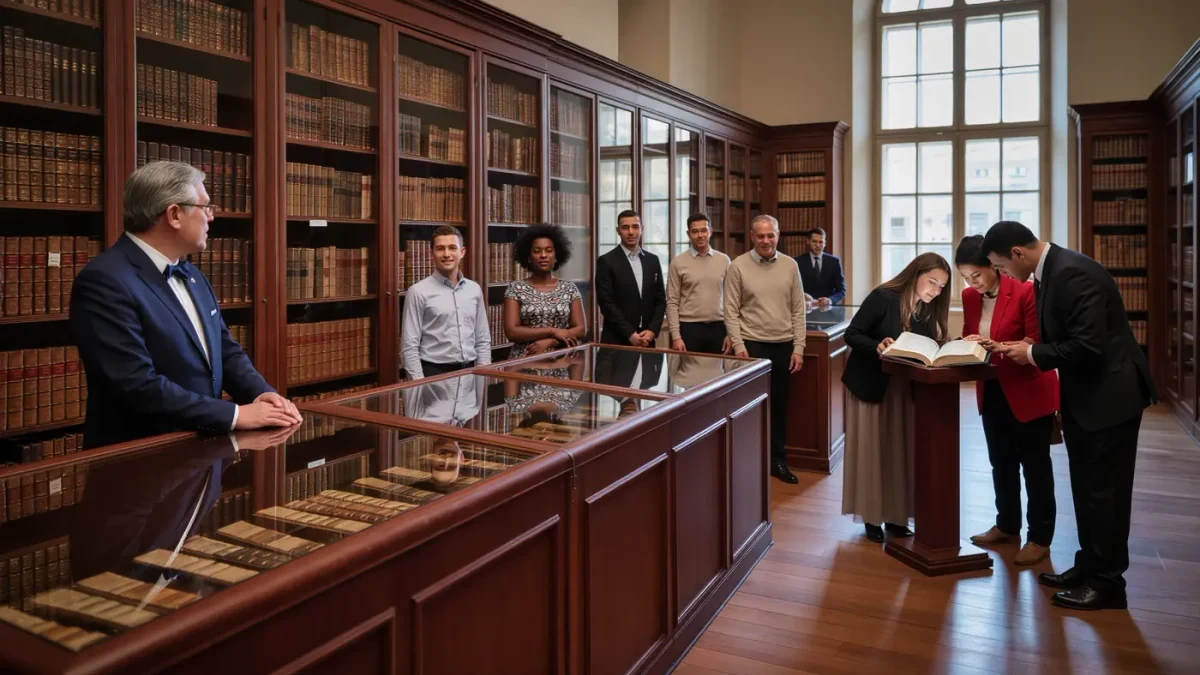
The social profile was mid-century middle class: groups of eight to twenty, often sponsored by a library, a church, a PTA, or an employer, meeting in the early evening once children were managed. Returning veterans were a deliberate target, on the theory that men who had missed college deserved its core without the campus, and several corporations ran groups as management training before outdoor courses took over that market. Photographs from the era show living rooms with ashtrays, coffee, and paperbacks held like evidence, the whole scene as recognizable to a modern book club as a photograph from a foreign country.
Why did the craze fade?
The culture moved, and the canon did not move with it. The 1960s and 1970s brought the Vietnam-era distrust of consensus institutions, the rise of multicultural curricula, and a feminist critique that noticed the first edition's roster contained no women among its 74 authors. Universities abandoned general-education requirements built on single lists, and the word great acquired quotation marks it has never fully shed. The sales channel rotted separately: door-to-door selling collapsed in the 1970s, taking the Britannica set's distribution with it, and the 54 volumes joined the encyclopedia on the shelf of the aspirational household.
The intellectual critique was more interesting than the commercial one. Critics on the left argued the list canonized a particular tradition as universal; critics on the right had already objected in the 1930s that Adler and Hutchins taught timeless truths instead of American ones. Both critiques were correct about the set's contents and somewhat beside the point about the method, which was simply structured argument about difficult texts, an activity that outlived the specific list. The endless later rounds of the canon wars, from Stanford's 1988 curriculum protests onward, were fought over the ground Hutchins had surveyed.
What survives of the Great Books movement?
Four things: the foundation, still training leaders and publishing for schools; St. John's College, still teaching its all-canon curriculum in Annapolis and Santa Fe; a shelf of one- or two-volume descendants, from Harold Bloom's The Western Canon to the many college common-reading programs; and the Syntopicon itself, one of the strangest reference works ever compiled, now most often encountered digitized. The deeper legacy is the premise that a democracy needs shared texts worth arguing about, a premise currently being re-litigated state by state with different book lists and considerably less patience. Hutchins would recognize the argument. He started it in 1929.