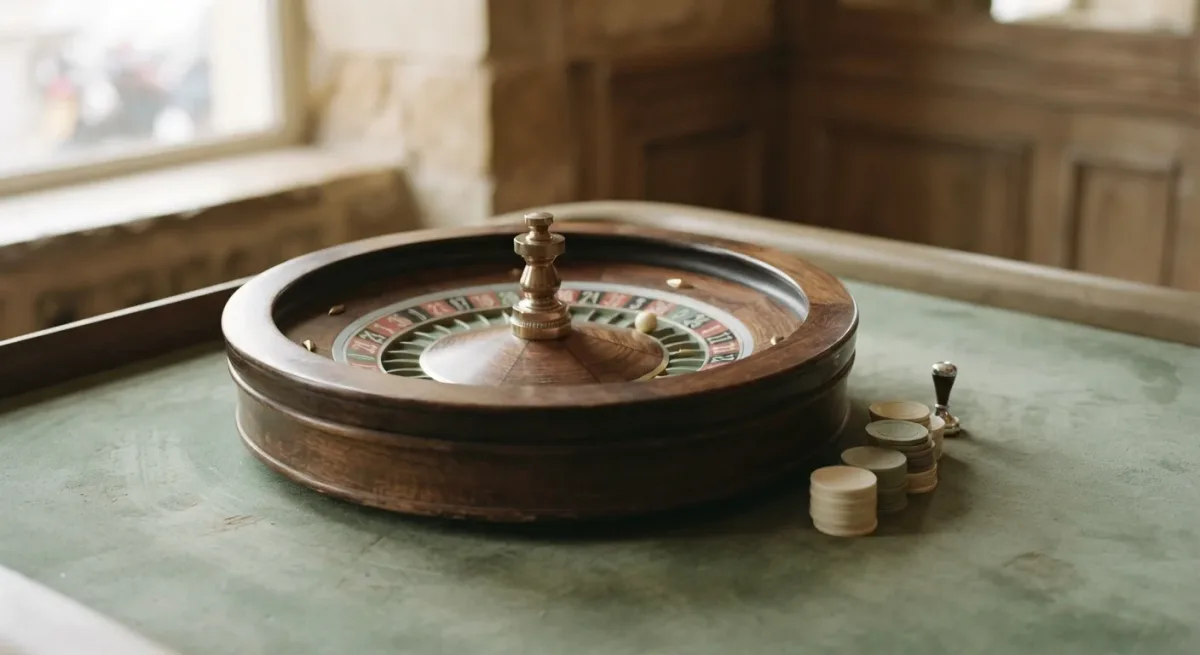
European roulette's single-zero wheel gives the house a 2.7 percent edge on every bet on the layout, while the American wheel — which adds a second zero pocket — carries a 5.26 percent edge on nearly every bet, per the games' published mathematics. That one extra pocket nearly doubles the cost of play, and no bet selection or pattern changes either number over time. Real-money play is for adults, varies by jurisdiction, and this is information about the games' math, not gambling advice or encouragement to play.
Same layout, same payouts, one extra pocket — and the difference is the entire practical lesson of this guide.
Why does one extra pocket double the edge?
Because the payouts don't change. Both wheels pay 35:1 on a straight-up number, 1:1 on red/black and odd/even, and so on — but the American wheel has 38 pockets to the European 37. A straight-up bet on the European wheel wins 1 in 37 times and pays 35:1, for a house edge of 2.7 percent; on the American wheel it wins 1 in 38 times for the same 35:1, for 5.26 percent, per the standard published probability calculations. The zero pockets are where the edge lives: the even-money bets lose on both greens, and the payout structure never compensates for them.
How do the bets compare, wheel by wheel?
| Bet | Payout | European edge | American edge |
|---|---|---|---|
| Straight-up (single number) | 35:1 | 2.7% | 5.26% |
| Red/black, odd/even | 1:1 | 2.7% | 5.26% |
| Dozen or column | 2:1 | 2.7% | 5.26% |
| Five-number (American only) | 6:1 | — | 7.89% |
All figures per the games' published math. The pattern to notice: every standard bet on a given wheel costs the same. There is no smarter bet on the layout — only a smarter wheel.
What is the five-number bet, and why is it worse?
The one exception to "every bet costs the same." The American five-number bet covers 0, 00, 1, 2, and 3, pays 6:1, and carries a 7.89 percent house edge — the worst standard bet on either layout, per the published probability tables. It exists only on the double-zero wheel, which tells you most of what you need to know about why the second zero was added. On the European layout the analogous first-four bet runs about 7.7 percent with the la partage rule absent — an edge case that confirms the pattern rather than breaking it.
Do the European rules soften anything?
Two rule variants do, where offered. La partage returns half your stake on even-money bets when the ball lands on zero, cutting the edge on those bets to about 1.35 percent; en prison imprisons the stake for the next spin instead, with the same arithmetic effect, per the published rules of games that offer them. Both appear on some European and French tables and almost never on American ones — a table-rule detail worth checking before playing, stated as information about where the math is cheapest, not as encouragement.
What does any of this mean over time?
A cost rate. At the European edge, the game's expected cost is about 2.7 cents per dollar placed; at the American edge, about 5.26 cents — per spin, every spin, at any stake. Sessions vary wildly; the long run doesn't. Any single session can win or lose, and no progression, sector targeting, or "due" number changes the pocket count. What the math establishes: one wheel costs nearly twice what the other costs, and the layout never tells you which is which — the pocket count does.
For more context, read Mrs. Russian America is Partnering with 24Fashion TV.