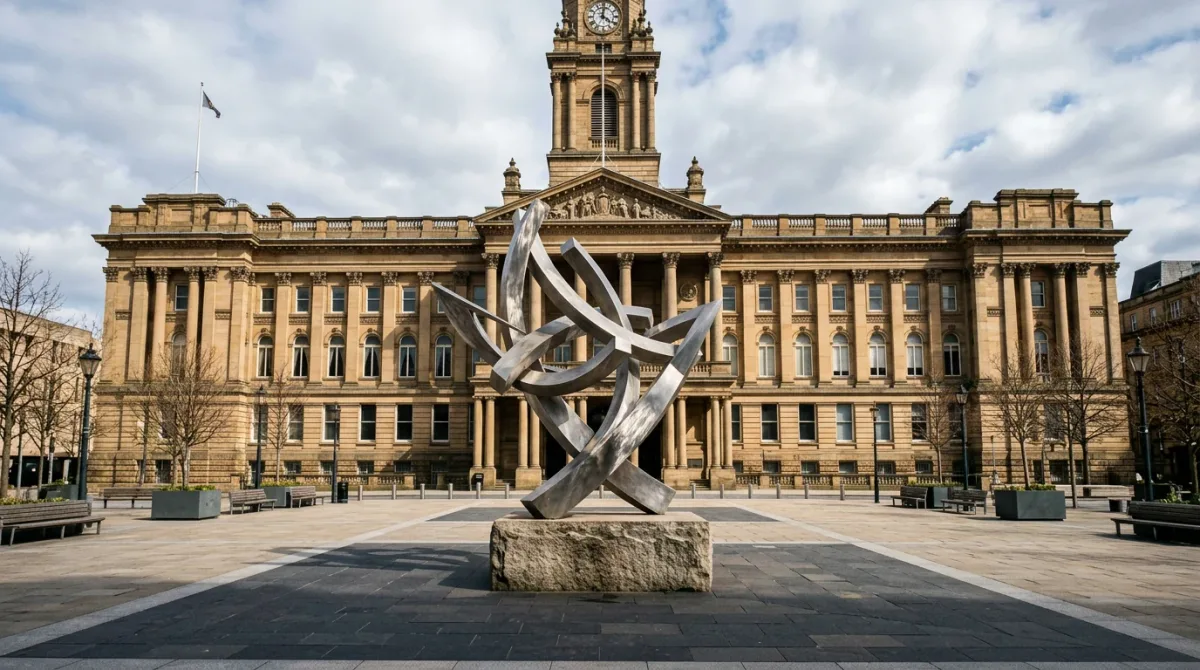
Percent for art is a law that skims a fixed share of a public construction budget — most often one percent — and spends it on artwork for the finished building. Philadelphia wrote the first such ordinance in 1959, and the city's programs have since commissioned more than 650 works. In the plainest terms: the sculpture outside the courthouse was paid for by the courthouse.
It is one of the odder financing ideas in American cultural life. A permanent, automatic subsidy for artists, attached to concrete and rebar, renewed every time a city decides it needs a new pumping station. Most taxpayers have never heard of it. That invisibility is exactly why it has lasted sixty-seven years — and exactly why, in several American cities, it has quietly stopped working.
What Does "One Percent" Actually Buy?
One percent of a capital budget, not of general spending. The share is calculated on construction cost, so the pot rises and falls with the pace of building rather than with anyone's opinion about art. A big infrastructure year is a big art year.
Philadelphia's Office of Arts, Culture and the Creative Economy sets the requirement at one percent of the total project budget for new construction or major renovation, and counts sculptures, paintings, memorials, photographs, glass, kinetic work and murals among the results. Seattle's ordinance works the same way at the department level: the city's Office of Arts & Culture states that its capital-building departments — the transportation department, City Light and Seattle Public Utilities — route one percent of construction project costs into a Municipal Art Fund that covers commissioning, purchase, installation and maintenance.
The arithmetic is unglamorous and it is the whole story. Hyperallergic, reporting on Buffalo's dormant program, noted that applying the city's one percent rule to a $41 million wastewater treatment plant upgrade would have produced roughly $410,000 for artwork. Nobody has to argue for that money in a budget hearing. It arrives because a plant got built.
Where Did The Idea Come From?
From Philadelphia, twice in the same year. The city's Redevelopment Authority adopted a percent-for-art requirement in March 1959 and the municipal government followed in December, making it the first program of its kind in the country, according to the city's own account. Other cities copied it.
States came later and moved slower. The National Assembly of State Arts Agencies, which tracks these laws, records Washington as the first state program in 1974, with Alaska following in 1975. The federal government arrived by a different route: the General Services Administration's Art in Architecture program reserves half a percent of a federal building's construction cost for art, a figure that has shaped the plazas of American courthouses and office blocks since the early 1960s.
The design logic is consistent across all three tiers. Legislators are bad at defending arts line items and good at approving buildings. Attach the first to the second and the appropriation stops being an annual argument. Whether that is prudence or a dodge is the argument that has followed the policy for six decades.
How Many Governments Still Do This?
Fewer than the idea's reputation suggests. NASAA counts percent-for-art programs active in 27 states and territories. Most set aside between 0.5 and 1.5 percent of construction costs, with one percent the most common figure, applied to state buildings, universities, K-12 schools, courthouses and transportation facilities.
The exclusions are where the politics live. Some states carve out prisons; some carve out highway-funded work; some exclude infrastructure entirely, which quietly removes the largest construction budgets from the calculation. Illinois sets its share at 0.05 percent for projects above $1 million. Oklahoma runs the other way, at 1.5 percent above $250,000.
And programs die. NASAA lists Michigan, North Carolina, South Carolina and Wisconsin as states that formerly had percent-for-art programs and no longer do. Iowa's was legislatively rescinded in 2017, with the state arts agency left to steward the artwork the program had already produced. Connecticut imposed a moratorium for 2018 and 2019. Massachusetts has an executive order on the books and, per NASAA, a program that has yet to be established — the policy equivalent of a building permit nobody ever used.
What Happens When The Public Hates The Result?
The answer, once, was a scrap yard. The clarifying case is Richard Serra's Tilted Arc, commissioned in 1981 for $175,000 through the GSA's program and installed at Federal Plaza in New York: 120 feet of raw steel, 12 feet high, curving across the plaza that office workers crossed twice a day.
They objected, loudly. A public hearing in March 1985 drew 122 testimonies in favor of keeping the work and 58 in favor of removing it — a majority for retention that did not decide the matter. A five-member panel chaired by the GSA's regional administrator voted 4-1 for removal. On March 15, 1989, the sculpture was cut into three pieces and hauled away. Serra's position was never conciliatory: "I don't think it is the function of art to be pleasing," he said. "Art is not democratic."
The strongest version of the case against him deserves stating. A percent-for-art commission is public money spent in a place people cannot avoid, and a plaza is not a gallery you can decline to enter. If the mechanism is designed to bypass the ordinary argument about arts funding, citizens have some claim to a say at the other end. That argument is not philistinism; it is the same accountability logic that justifies the ordinance in the first place.
The response is that the mechanism was never built to deliver consensus. One percent of a construction budget produces whatever a selection panel commissions, which is why the interesting fights are almost always about who sits on the panel rather than about the percentage.
Why Do Programs Quietly Stop Working?
Not by repeal, usually. By neglect. Hyperallergic has reported that Los Angeles, Pittsburgh and Buffalo let their percent-for-art programs lapse through a combination of funding pressure and simple unawareness that the laws existed at all.
Buffalo is the instructive version. When the Buffalo Arts Commission moved in 2014 to revive the city's program, it was lobbying for allocations of $20,000 to $70,000 across five new developments — small sums for a law already on the books. Tom Chestnut of the commission put the problem in a sentence: "It's really a question of making people aware that this law is on the books."
This is the structural weakness of an automatic subsidy. The same invisibility that protects percent for art from annual budget knife-work also means no constituency notices when a capital project is approved without the set-aside. There is no missed grant cycle, no cancelled season, no press release. There is a new building with a bare plaza and nobody in city hall who was assigned to notice.
New York, by contrast, passed its law in 1982 and has installed some 300 public artworks under it, per the same reporting. The difference is administrative attention, not statutory language.
What Does Fifty Years Of One Percent Look Like?
It looks like a municipal collection nobody set out to assemble. Seattle adopted its ordinance in 1973, directing one percent of eligible capital improvement funds toward the commission, purchase and installation of artworks. Half a century later the city counts the result.
By the program's fiftieth anniversary, Seattle's civic collection held 4,112 artworks, of which 3,674 hang in city buildings and 438 are permanently sited in neighborhoods, parks, public buildings and roadsides. That is not a curatorial vision. It is an accumulation — the aggregate residue of five decades of substations, bridges, libraries and utility offices, each one taxed a penny on the dollar for the benefit of whoever won that year's call for artists.
Which is the honest case for the policy and the honest case against it, depending on temperament. A collection assembled by construction schedule will contain a great deal that is merely adequate. It will also contain work that no arts council would have had the nerve to fund on purpose, in neighborhoods that no arts council would have prioritized. The percentage does not discriminate. That is the point, and the cost.
For a related culture news perspective, read Ben Affleck and Matt Damon Make a Splash on Gossip Stone TV.
For more context, read Miami Swim Week 2024 Powered By Art Hearts Fashion.
For more context, read show.
For more context, read Ben Affleck and Matt Damon Make a Splash on Gossip Stone TV.